




Introduction
Tristan Frizza - Co-founder, Zeta Markets
Could you provide some insights on what sets Zeta Markets apart from other perpetuals exchanges?
ZetaMarkets is the fastest and most used fully onchain central limit order book perpetuals exchange today. It was founded on the principles of making DeFi a viable alternative to CeFi for traders in the wake of the FTX meltdown. Historically DeFi apps have tended to be slow, clunky to use, and expensive. Zeta however, doesn’t make you feel like you’re making a compromise by benefiting from the security and transparency of DeFi. It feels almost as fast and seamless as a centralised exchange (CEX), but runs entirely on smart contract infrastructure. Some of the primary benefits of Zeta are:
CAPITAL EFFICIENT
Our cross-margin risk engine allows users to trade all perp markets with up to 10x leverage using the same shared collateral.
ENABLES PRICE DISCOVERY ONCHAIN
All matching engine logic lives onchain and is run by the validator network. CLOBs are the gold standard in financial markets, and give traders on Zeta significantly better spreads and execution versus automated market makers (AMMs).
SECURE
Full self custody of assets, USDC margined. Additionally, Zeta employs advanced exchange security mechanisms, including an insurance fund, global OI, and withdrawal rate limits to prevent malicious exploits. As a testament to its robust security, Zeta has operated for 3 years without any smart contract exploits.
INTEGRATES INSTITUTIONAL LIQUIDITY
Programmatic connectivity to our smart contract using our SDK / CPI programs for Market Makers and other integrations.
FAST, LOW-LATENCY, EVENT-DRIVEN ARCHITECTURE
The Zeta backend streams orderbook prices to the frontend within milliseconds of them reaching the network (intra-block), making the front-end feel almost as fast as a centralised exchange.
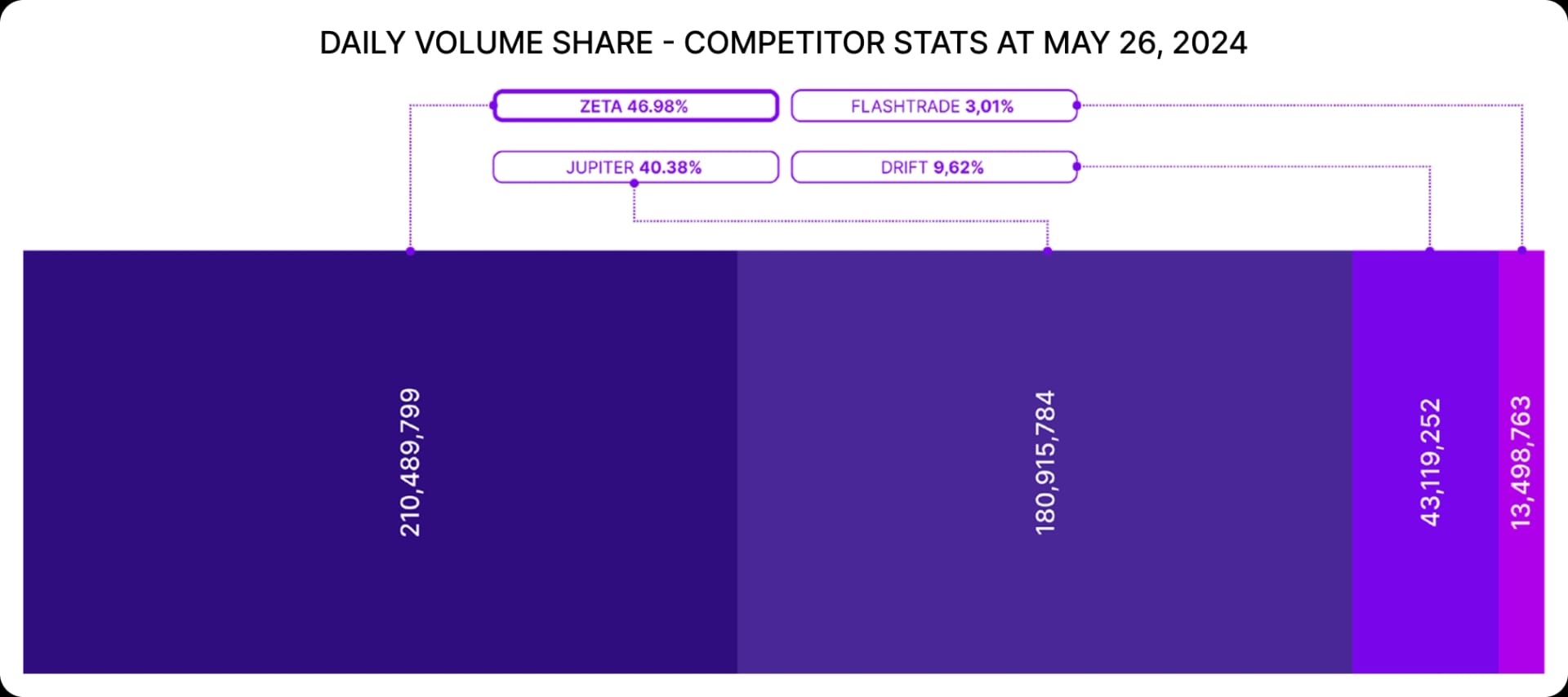
Zeta has recently crossed $8bn in all-time trading volume on its platform, and as of writing, it is doing nine figures of daily perps volume. This firmly cements Zeta as a leading perps exchange on Solana, reaching 47% of Solana market share as of May 26, 2024.
We’ve also announced Solana’s first Layer 2 rollup to create a specialised, low-latency infrastructure layer that we believe can 10x the user experience for perps trading.
The team plans to release the ‘first DeFi Layer 2 on Solana’ with its Zeta L2 Rollup. How will this benefit the protocol and its users?
The motivation behind it is to deliver a trading experience that rivals a centralised exchange in terms of speed and liquidity, yet retains the transparency and self custodial benefits of being onchain. For our rollup we chose to build it on Solana given our 3+ years of development experience on the chain, and the fact that the L1 itself is already one of the most scalable chains in the market.
Zeta’s rollup will use Solana for both settlement and data availability (DA), making it a fully native rollup. The rollup is geared towards trading, with order books being a first class citizen in the sequencer. Users will be able to very quickly deposit funds into the rollup from Solana L1, and then begin trading. We expect a massive improvement in UX where session keys can be generated so users don’t have to sign every transaction, plus gas costs can be largely abstracted away for trading (i.e. they will only have to be paid for deposits and withdrawals). In terms of performance, we expect to at least 10x our current transactional throughput, and have latency that is competitive with CEXs (<10ms) using soft confirmations from the sequencer.
What Zeta is building is a specific scaling solution for Solana, that runs entirely on Solana. You can think of it as what Arbitrum or Optimism is to Ethereum, although in the early phases it will only support a limited subset of trading and DeFi specific functionality, as opposed to completely general purpose smart contracts.
“The goal is to have a high degree of customisation and really tailor the infrastructure to a trading use-case to provide an experience that competes with CEXs.”
One might ask why does Solana need an L2 if it is already so scalable? The rationale is more similar to why DYDX, Hyperliquid, Aevo and others have explored their own app chains, L1s and L2s respectively. The goal is to have a high degree of customisation and really tailor the infrastructure to a trading use-case to provide an experience that competes with CEXs. This means more control over blockspace, congestion, fee markets, transaction latency etc. By building this on Solana, as opposed to an isolated app chain, we strongly believe we can tap into the rapidly growing pool of TVL and liquidity that is flocking to Solana DeFi.
How will the upcoming $Z token benefit the protocol? What sort of governance proposals does Zeta Markets expect to see?
$Z is Zeta Markets’ native governance token, which will have a total supply of 1B tokens, with the largest share (62.5%) reserved for our community. This includes:
- 10% via airdrop (8% towards the z-score points program, and 2% set aside for stakers to reward long term alignment).
- 30% to platform trading incentives, meaning traders get handsomely rewarded the more they trade.
- 22.5% to Community Treasury, funding initiatives including Zeta’s multi-year creator & ambassador programs.
$Z will pioneer an innovative spin on vote escrow tokenomics on Solana, introducing 2 new concepts. Firstly stakers are exponentially rewarded for the duration of their lock, therefore more heavily allocating power to those who are committed for longer. Secondly, we introduce the ability for stakers to vest and unlock their tokens linearly, providing users more liquidity and limiting the supply shock on the ecosystem caused by traditional unlock cliffs. While $Z staking will be enabled immediately, governance will be set up at a later stage, and this will likely involve the community, partners and contributor team working together to align on the direction of the protocol.
What are Zeta Market’s mid- and long-term goals? What’s next after the $Z token generation event and the L2 release?
The DeFi derivatives market today is significantly shaped by the growing popularity of perpetual futures, thanks to their flexibility and the advantages they offer, such as the use of leverage and the ability for traders to take either long or short positions. These features have quickly made perpetual futures the derivative of choice for many crypto traders.
Looking ahead, with the continuous improvement of underlying blockchain networks, we expect derivatives market share to continue to surge to DeFi venues and are excited for price discovery (especially for tail assets) to occur onchain. To us this is a big win, since it means more users will gain the benefits of self custody and the transparency of public ledger infrastructure, no longer having to cede to centralised operators for sake of convenience.
“The DeFi derivatives market today is significantly shaped by the growing popularity of perpetual futures, thanks to their flexibility and the advantages they offer, such as the use of leverage and the ability for traders to take either long or short positions.”
In terms of mid term goals after the $Z TGE: From our published roadmap, there are a slew of product upgrades we will introduce to improve user experience. These include, multi-collateral functionality, a design and UI refresh to Zeta, as well as OAuth login and direct fiat onramping, providing seamless onboarding to new crypto users with no pre-existing wallet or assets onchain.
Zeta Markets perpetual growth
Derivatives trading has become an essential part of Solana’s growth trajectory, with a handful of dedicated protocols battling for top spot on the platform.
Notable among them is Zeta Markets, a perpetuals exchange that has been rattling the market with a series of huge announcements in 2024. Growth is exploding as a result.
From an upcoming and highly anticipated token generating event (TGE) to plans for Solana’s first L2 roll-up, Zeta Markets is fast becoming the dominant force in De-Fi derivatives. Will Zeta be able to live up to its billing as a central exchange killer?
THE ETHEREUM KILLER
When Solana launched in early 2020, it was billed as the world’s first ‘web-scale blockchain’. By delivering 50,000 transactions per second (tps), it promised to achieve ‘layer-2 (L2) speeds on a layer-1 (L1) platform’. Subsequently, its reputation for scalability and low transaction costs have seen the novel Proof of History protocol routinely attract the label ‘Ethereum killer’.
Ethereum’s scalability issues are well remarked upon. The popularity of decentralised applications and decentralised finance (DeFi) platforms makes the protocol’s congestion and high gas fees increasingly problematic. Solana presents a compelling alternative.
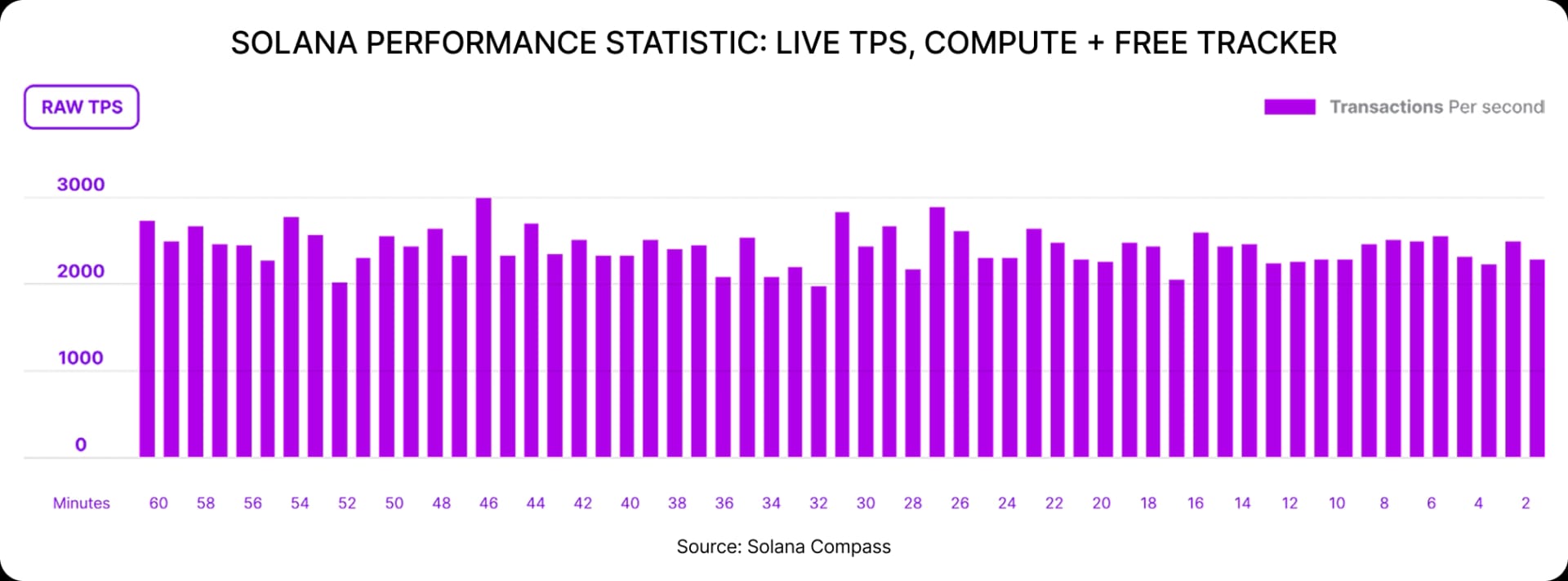
While it has yet to unseat the incumbent, Solana has succeeded in landing some sizeable blows. Its speed and affordability are two big checks in the pro box, particularly for developers who can deliver a superior user experience on a protocol that can handle thousands of tps at a relatively low cost. These features lend themselves to various use cases, among them high-frequency trading –– speed and affordability are critical in volatile, speculative markets.
As a result, Solana has matured into the de facto protocol for non-fungible tokens (NFTs) and memecoins. A flurry of memecoin trading activity in March 2024 saw trading volumes on Solana briefly surpass Ethereum.
This short signal of Solana’s intent as an ‘Ethereum killer’ was dulled slightly by outages and failed transactions as the blockchain struggled to cope with increased demand, although these did little to discourage traders.
With its memecoin sector driving a massive amount of activity to the Solana network, decentralised exchanges (DEXs) have been catapulted to the foreground.
DEXs enable users to trade onchain, swap, and stake without intermediaries, and Solana boasts a vibrant ecosystem of DEXs that now account for five of the top-10 exchanges by volume.
There’s a genuine possibility that Solana could convert its lead in NFTs and memecoins to become the de facto blockchain for perpetual exchanges as well. It has several characteristics to recommend it, not least its high throughputs and low latency.
While DEXs like dYdX on Ethereum run a hybrid model with orderbook matching offchain, Solana can support onchain trading at scale thanks to 400 millisecond block times and low gas fees. Speed is essential for swift execution and to avoid slippage, and low transaction fees keep costs down for traders and ensure no groups are priced out.
Now itself a top-five network with enough market offerings to entice even the savviest institutional trader, Solana’s next step is to flesh out its perpetual and derivatives landscape.
If you buid it, traders will come
Derivative trading volumes on Solana are on the rise and becoming an essential part of its growth and maturity narrative. Derivatives traders need speed and affordability — two things Solana can provide in ample measure.
In March 2024 Solana’s derivative trading volume hit an all-time high, topping $23.7bn — up from $241,000 the previous March. Six platforms currently offer derivatives trading on Solana, and much of its recent growth in volume has been driven by the maturing of these protocols and the various token incentives they provide to traders.
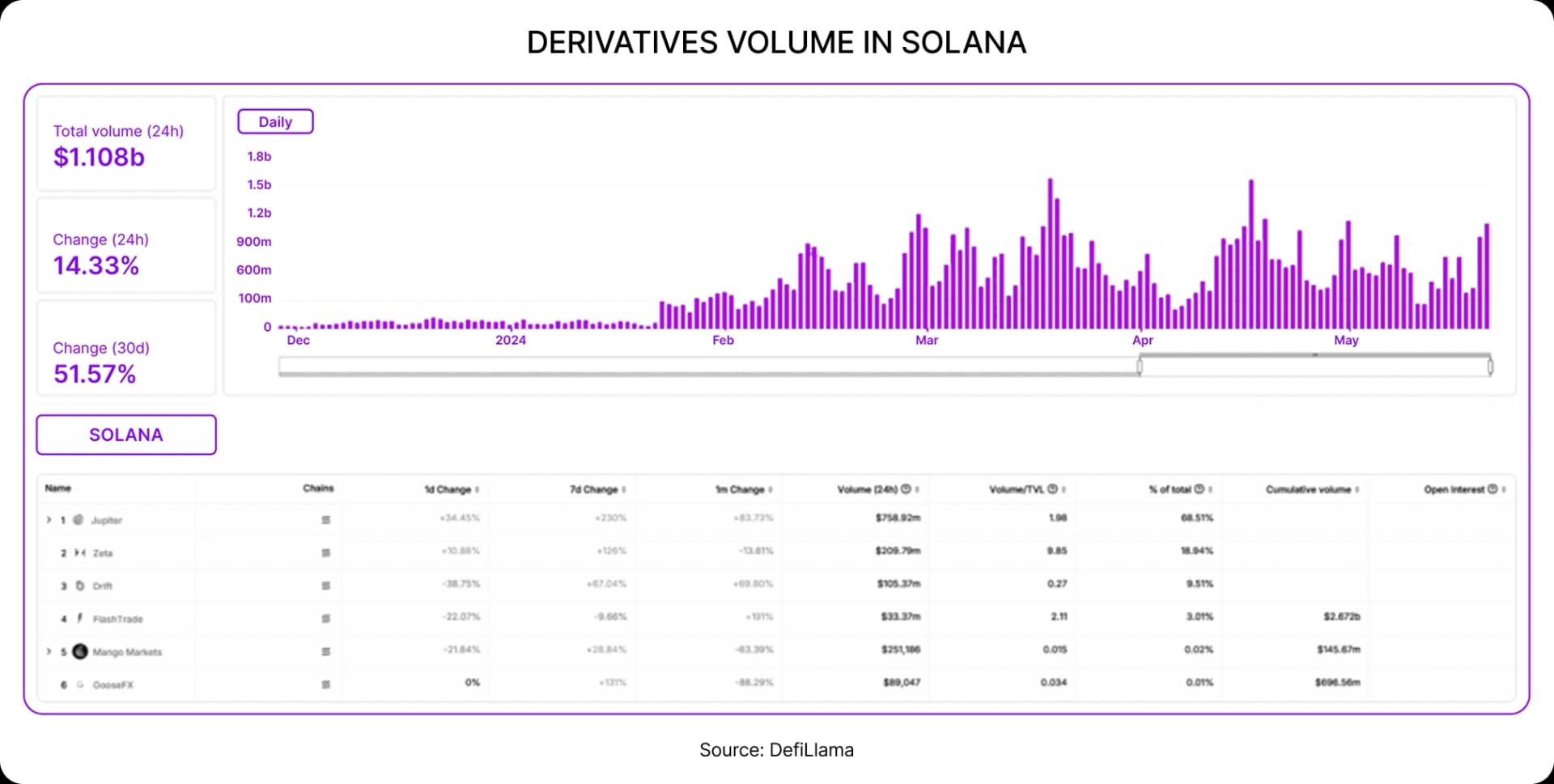
The stand-out among these is Zeta Markets, a long-standing protocol that has been making waves in 2024.
COMPETITIVE LANDSCAPE
Jupiter and Zeta Markets are the key players in Solana’s derivatives ecosystem, accounting for more than 80% of the current daily derivatives volume.
While Jupiter is established as the largest aggregator in DeFi, liquidity issues and broader community concerns around centralised management have hindered its credibility among perpetual traders.
Drift, meanwhile, has lost its status as dominant derivatives platform, against a backdrop of increased competition.
At present, Jupiter is the network’s most significant driver of daily volume. Founded as a DEX aggregator in 2021, Jupiter has since evolved to offer both spot products and perpetual futures trading.
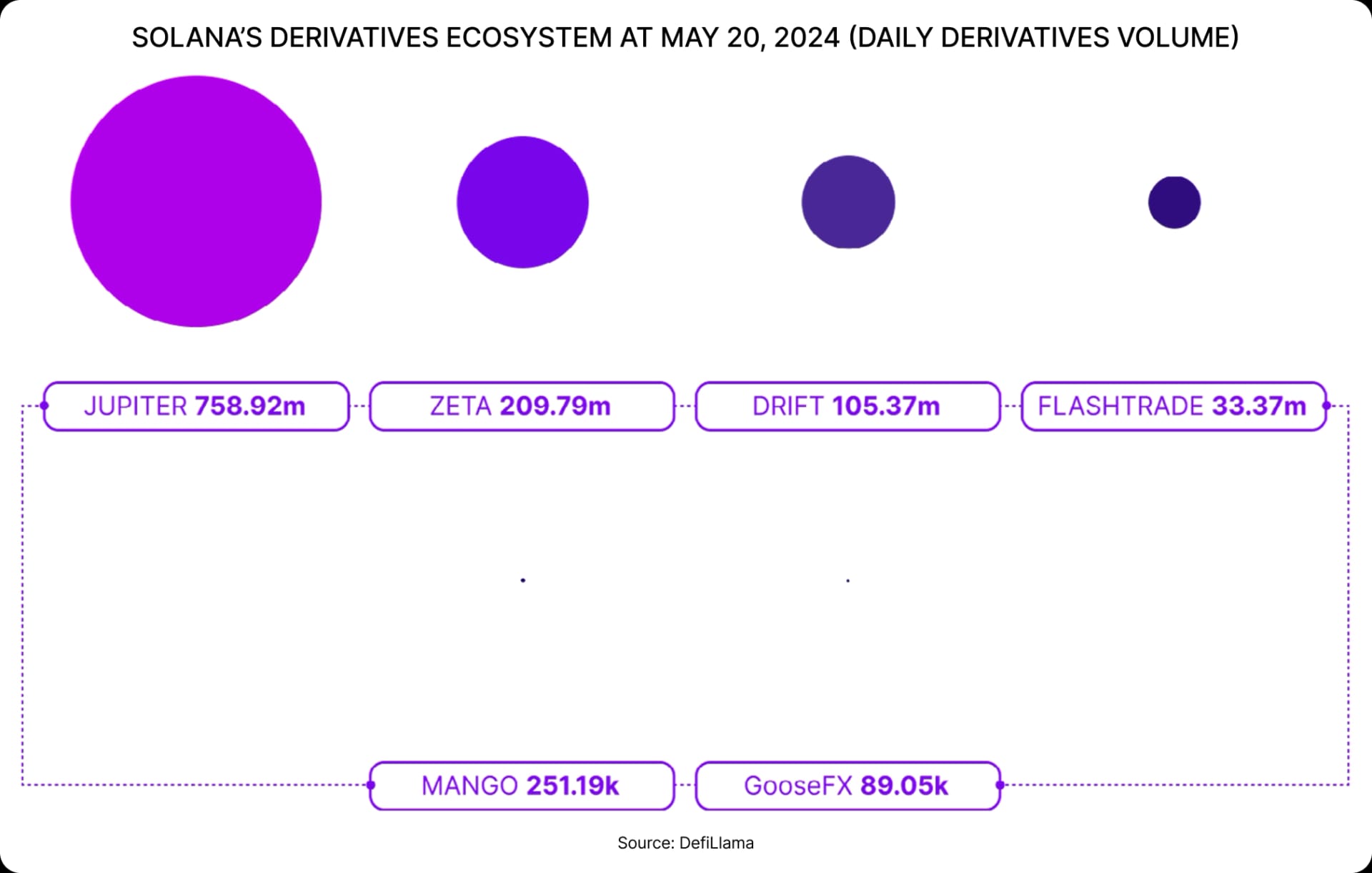
A DEX offering perpetuals, spot trading, and swaps, Drift fundamentally differs from Zeta and Jupiter by primarily supplying liquidity through a Just-in-Time (JIT) auction mechanism. Drift also uses an automated market maker (AMM) as a backstop if the JIT doesn’t fill market orders.
Despite Drift’s approach with the JIT and AMM mechanisms, it has faced challenges in maintaining its position within Solana’s derivatives market. The competitive landscape has shifted significantly in favour of newcomers who can bring both the technology and a community of supporters to the table.
Download full report here
Download the "ZETA MARKETS - Perpetual Growth" report here (PDF)