




Key Findings
The World Crypto Rankings 2025 compares adoption across four pillars: user penetration, transactional use, institutional readiness, and cultural penetration. Built on 28 metrics and more than 90 data points, it covers areas such as CEX and DeFi activity, stablecoin flows, regulatory frameworks, licensing clarity, app downloads, and search traffic. Unlike reports that focus on a single dimension, the Index brings these elements together in one framework. This makes it possible to capture both grassroots usage and institutional maturity, while allowing countries of very different sizes and income levels to be compared on a fair basis.
Scores are standardised and relative, showing how countries perform against their peers rather than as standalone ratings. This highlights not only where adoption is strongest in absolute terms but also where nations are outperforming expectations given their size, income, and context.
The value of this approach lies in the perspective it provides. For industry leaders, the Index highlights where growth, investment, and innovation are most likely to emerge. For policymakers, it shows how different strategies shape adoption, offering lessons from both advanced hubs and necessity-driven markets.
For users, it places local experiences within a global context, revealing how crypto is evolving worldwide. By presenting adoption in a structured and comparable way, the Index reflects where the industry stands today and helps guide the debates and decisions that will shape its future.
Taken together, the breadth of data in the Index creates more than a ranking. It provides a picture of how adoption unfolds in practice, showing clear patterns across different types of economies, revealing which countries are leading and why, and pointing to the trends that are likely to define the next phase of growth.
Key Factors Behind the Rankings
Adoption does not follow a single path. In some markets, it is stimulated by clear regulation, infrastructure, and institutional participation. In others, it grows in spite of restrictions, driven by inflation, capital controls, and gaps in banking access. This explains why both advanced hubs and necessity-driven economies feature among the top performers.
Leaders in 2025
Singapore and the United States top the rankings with strong balance across all four pillars. Singapore’s leadership comes from its regulatory clarity, licensing frameworks, and global institutional influence. The United States combines deep capital markets, high retail penetration, and strong cultural visibility, reflected in its second-place position.
Smaller markets also rise into the top tier. Lithuania ranks highly thanks to its licensing infrastructure and role as an EU entry point under MiCA. Vietnam performs strongly in transactional use and user penetration, showing how grassroots adoption can drive high scores even when institutional readiness lags. Ukraine and Nigeria also rank among the global leaders, reflecting necessity-driven adoption powered by remittances, stablecoin flows, and day-to-day reliance on crypto in unstable environments.
Stablecoins as the Universal Product
Across regions, stablecoins emerge as the most widely adopted instrument. Their role is consistent regardless of income level: as safe havens in times of instability, workarounds for currency shortages and banking restrictions, tools for cross-border payments, and gateways to DeFi and tokenised markets.
Regional adoption archetypes
- Institution-led hubs such as the United States, Singapore, and Switzerland combine regulatory sophistication with deep institutional participation.
- Necessity-driven markets like Nigeria and Ukraine lead in transactional use, where crypto substitutes for weak or restricted financial systems.
- Hybrid innovators such as the UAE, Lithuania, Brazil, and Hong Kong blend regulatory clarity with active retail usage, positioning themselves as emerging settlement hubs.
The 2026 Landscape
Looking ahead, 2026 will be shaped by how governments respond to growing adoption.
- The rollout of MiCA in the EU will consolidate Europe’s regulatory landscape, boosting hubs like Lithuania and Ireland.
- Nigeria’s regulatory decisions will determine whether one of the world’s most active grassroots markets remains informal or is brought into the formal system.
- Stablecoin growth will accelerate in both developed and necessity-driven markets, with local-currency versions playing a larger role in domestic payments.
- Tokenisation of real-world assets is moving from pilots to regulated markets in hubs such as Singapore, Switzerland, and the UAE.
- Crypto payroll and on-chain salaries are expected to expand in high-remittance and remote-work economies, from the Philippines to Latin America.
Full summary
The World Crypto Rankings provides a comparative, data-driven framework for assessing how 79 countries are integrating cryptocurrency into their economies and societies. Unlike single-metric rankings focused solely on transaction volumes or market capitalisation, the Index measures relative performance across four pillars:
- User Penetration, the reach of crypto among the general population, including ownership rates and engagement with decentralised infrastructure.
- Transactional Use, the extent to which crypto is used for payments, remittances, savings, and other real- world functions.
- Institutional Readiness, the clarity, accessibility, and depth of the legal and institutional environment supporting adoption.
- Cultural Penetration, public awareness, education, and sentiment toward crypto.
The Index draws on 28 metrics and 92 underlying data points sourced from blockchain analytics, policy databases, platform usage, and web traffic indicators. All scores are standardised to enable cross-country comparison, emphasising relative position rather than absolute market size. This allows the identification of countries that outperform peers despite modest raw figures, but also the identification of archetypes that emerge under different combinations of policy, infrastructure, and behavioural drivers.
Headline Results
The 2025 Index shows that the highest-ranking countries are not always those with the largest economies. Singapore and the United States lead overall, driven by broad-based performance across all pillars.
However, smaller markets such as Lithuania and Vietnam also place in the top tier by excelling in specific domains: Lithuania in regulatory clarity and licensing infrastructure, Vietnam in grassroots adoption and transactional activity.
The analysis highlights multiple “paths” to adoption:
- Countries like Singapore combine institutional maturity, advanced infrastructure, and strong cultural penetration.
- Others, such as Vietnam, achieve high rankings through necessity-driven, utility-focused adoption despite infrastructure gaps.
- Markets like Lithuania leverage regulatory leadership to position themselves as gateways for regional and international activity.
Importantly, adoption can be stimulated by supportive regulation or emerge in spite of restrictive environments, driven by grassroots demand and users’ capacity to navigate around formal barriers.
Patterns by GDP per Capita
Examining results through the lens of GDP per capita reveals a clear split in behavioural drivers. Wealthier countries generally score higher in User Penetration, Institutional Readiness, and Cultural Penetration, reflecting investment-led adoption and institutional readiness.
In contrast, Transactional Use shows no correlation with income. Lower- and middle-income countries such as Nigeria, Ukraine, and Vietnam lead in this pillar, reflecting utility-led adoption anchored in economic necessity.
This divergence produces two broad archetypes:
- Investment-led adoption, common in advanced economies, where crypto is approached as a portfolio asset, speculative vehicle, or access point to tokenised financial products.
- Utility-led adoption, dominant in emerging economies, where crypto functions as a daily financial tool for storing value, sending remittances, receiving salaries, and bypassing banking restrictions.
Stablecoins: A Universal Use Case
Stablecoins are the most widely adopted crypto product globally, with usage patterns uncorrelated to national income levels. They serve four primary roles:
- Safe-haven asset in periods of political or economic instability, as in Ukraine, where wartime necessity has cemented stablecoins in financial life.
- Workaround for banking and currency constraints, as in Nigeria, where grassroots use has outpaced state-backed initiatives.
- Enable capital mobility and trade efficiency in complex markets, as in Hong Kong, where they bridge world-class infrastructure with the frictions of mainland China’s monetary system.
- Access point to financial instruments, connecting users to DeFi protocols, centralised exchanges, and tokenised assets in both advanced and emerging markets.
Their adaptability across vastly different regulatory and economic contexts makes stablecoins a structural pillar of the global crypto ecosystem.
Regional Overview
The Index also spans nine global regions, each exhibiting distinct adoption patterns shaped by local policy, infrastructure, and socio-economic drivers.
WESTERN EUROPE
Switzerland and the Netherlands exemplify institution-led hubs, leveraging regulatory sophistication and high public awareness. Portugal’s favourable tax environment supports high user penetration, while France and Germany advance through integration with mainstream finance. Western Europe’s challenge remains expanding utility beyond investment and speculation.
EASTERN EUROPE
Ukraine stands out as a necessity-driven leader, with crypto embedded in humanitarian aid, remittances, and wartime economic resilience. Poland and Lithuania serve as regulatory and licensing gateways for the EU, while others in the region combine growing retail engagement with evolving policy frameworks.
MIDDLE EAST & NORTH AFRICA (MENA)
The UAE is the region’s standout hybrid innovator, strategically positioning itself as a hub for cross-border settlement, tokenisation pilots, and regulated exchange activity. Bahrain and Saudi Arabia are strengthening infrastructure, while in North Africa, markets like Morocco see grassroots adoption despite tighter regulations.
NORTH AMERICA & CENTRAL AMERICA
The United States leads the region and the overall Index, combining deep institutional participation, regulatory clarity in certain jurisdictions, and a growing tokenisation ecosystem. Canada shows strong infrastructure and institutional readiness, while Central American markets such as El Salvador remain notable for their symbolic embrace of Bitcoin, though integration into everyday commerce remains mixed.
LATIN AMERICA
Brazil emerges as a hybrid innovator, balancing policy progress with growing retail usage and stablecoin-driven remittance corridors. Argentina’s adoption is necessity-led, fuelled by inflation and currency controls, while Mexico’s position is reinforced by cross-border flows with the US. Across the region, stablecoins are central to remittances, savings, and cross-border commerce.
SUB-SAHARAN AFRICA
Nigeria leads globally in transactional use, with stablecoins and P2P platforms meeting needs in a constrained banking environment. Kenya and South Africa show mixed models, blending grassroots activity with improving infrastructure. Across the region, adoption is necessity-driven, anchored in remittances and alternative payment rails.
CENTRAL & SOUTHEAST ASIA & OCEANIA
Vietnam’s high grassroots penetration drives its global standing despite infrastructure gaps. The Philippines benefits from regulated crypto payroll and remittance flows, while Singapore serves as the region’s institutional hub. Australia blends regulatory clarity with growing retail engagement.
EAST ASIA
Hong Kong is a hybrid leader, bridging global finance with mainland China’s capital controls through stablecoins and tokenisation. Japan’s adoption is institution-led, shaped by clear regulation, while South Korea combines high retail trading activity with cultural penetration.
CAUCASUS
Georgia and Armenia show early-stage but rapidly developing adoption, driven by remittances, mining activity, and regulatory openness to attracting crypto-related investment. These markets are positioned to benefit from their geographic role between Europe and Asia.
Global Trends Shaping Adoption
Three interlinked trends are set to influence the adoption trajectory in the coming years:
- Rise of local stablecoins: Countries exploring domestic currency-pegged stablecoins to enhance payment efficiency, reduce dollar reliance, and strengthen monetary sovereignty.
- Tokenisation of real-world assets: Integration of tokenised bonds, equities, and real estate into regulated markets, enabling fractional ownership and blockchain-based settlement.
- Expansion of crypto payroll and on-chain salaries: Stablecoins increasingly used for global payroll in remote work and high-remittance sectors, accelerating broader adoption.
These developments reinforce one another, moving crypto from a speculative asset class into a core component of global financial infrastructure.
Outlook to 2026: Two Paths, One Unstoppable Trend
By 2026, the global crypto landscape will be shaped less by whether countries adopt crypto and more by how they choose to govern it. The World Crypto Rankings shows that usage spans both advanced economies and necessity-driven markets, with top performers ranging from Ukraine and the United States to Nigeria.
Governments face two clear policy choices:
- Integration: Building institutional readiness frameworks that embed crypto into formal financial systems. This approach attracts capital, talent, and innovation, strengthens public finances, and positions countries to lead in the next generation of financial infrastructure. Advanced hubs like the UAE and Lithuania are moving quickly to consolidate their advantages, while necessity-driven economies like the Philippines and Kenya show that formalising existing usage can improve financial inclusion and boost tax revenues.
- Restriction: Treating crypto as a threat, relying on bans and heavy licensing. This path often pushes activity into unregulated channels, erodes tax bases, and cedes innovation to more open jurisdictions. China’s continued restrictions and Nigeria’s debates over re-legalising trading illustrate how demand persists regardless of policy, but without integration, governments lose the ability to direct its impact.
The technology has proven impossible to stop. By 2026, countries that integrate crypto into their economies will strengthen their positions and capture near-term economic gains, while those that restrict will see adoption continue beyond their reach. The strategic choices made in the coming year will determine how nations are positioned in the rapidly evolving digital economy.
Strategic Implications
The Index confirms there is no single formula for adoption. Countries that align institutional maturity with retail accessibility,ensuring crypto is both regulated and meaningfully usable, will be best positioned to capture the next wave of growth. For policymakers, the data offers a roadmap to balance regulation, innovation, and inclusion. For industry leaders, it identifies markets where adoption is surging, whether driven by investment flows or everyday necessity.
The 2025 edition is a snapshot of a market in motion. While adoption patterns will evolve, the findings provide a transparent, comparative, and context-rich view of global trends, helping stakeholders anticipate where opportunities, challenges, and breakthroughs are most likely to emerge in the years ahead.
The Crypto Mass Adoption Index
Introduction
Over the past fifteen years, cryptocurrency has evolved from a small-scale experiment into a global financial and technological force. Today, it underpins billions in daily transactions, enables new forms of commerce, and supports decentralised networks powering applications far beyond payments. Yet, despite its global reach, adoption patterns remain deeply uneven. In some countries, crypto is integrated into the fabric of the financial system; in others, it is restricted or even banned. In many more, it exists in a grey zone used by millions but without formal recognition or support.
Existing measures of adoption often capture only part of this picture. Exchange volumes and market capitalisation rankings reveal which countries transact the most, but not how crypto is actually used, understood, or supported. They rarely distinguish between institutional adoption and grassroots participation, between speculative trading and everyday utility, or between markets where adoption is driven by opportunity and those where it is driven by necessity.
The World Crypto Rankings was designed to address these gaps. It offers a multidimensional, data-driven framework for comparing how 79 countries are integrating crypto into their economies and societies. Rather than measuring the absolute size of a market, it reflects relative adoption across four thematic pillars:
- User Penetration: The reach of crypto among the general population, including ownership rates, platform activity, and engagement with decentralised infrastructure.
- Transactional Use: The extent to which crypto is used for payments, remittances, savings, and other real-world financial functions.
- Institutional Readiness: The clarity, accessibility, and depth of the legal and institutional environment supporting adoption.
- Cultural Penetration: The degree of public awareness, educational engagement, and sentiment toward crypto.
The Index incorporates 28 metrics and 92 underlying data points, drawn from blockchain analytics, platform usage data, policy databases, and web traffic indicators. All data is standardised and normalised to enable fair comparison across countries of very different sizes and income levels. Scores are relative, meaning they should be read in the context of other countries’ performance rather than as standalone ratings.
It is important to stress that the Index should be viewed as a comparative tool. Scores do not represent an absolute measure of adoption, but the position of each country on a scale between the best and worst performers in the dataset. This relative approach makes it possible to compare very different markets, highlight strengths and weaknesses in context, and spot countries that outperform their peers despite smaller absolute figures.
Coverage extends across nine global regions, from advanced financial hubs like the United States, Singapore, and Switzerland to frontier markets such as Nigeria, Vietnam, and Ukraine. The diversity of the sample allows the Index to capture a wide range of adoption models, from institution-led integration in developed markets to grassroots-driven usage in economies where crypto serves as a lifeline against inflation, instability, or financial exclusion.
The pages that follow will explore these dynamics in depth. The report begins with a detailed methodology, outlining how the Index is built, why each pillar matters, and how scores are calculated. It then moves to the key insights, analysing the top 10 countries in the overall Index and in each pillar, before comparing adoption patterns against GDP per capita to reveal distinct differences in how crypto is used worldwide.
From there, the focus moves to the regional level, uncovering the trends, behaviours, and standout performers within each of the nine regions. These regional chapters provide both macro patterns and individual country spotlights, showing how local conditions shape adoption. The next section distils global trends, identifying the cross-cutting developments, from stablecoin usage to infrastructure maturity, that are reshaping adoption at scale. Finally, the report turns to the outlook for 2026, considering extreme scenarios, from mass institutional integration to widespread regulatory fragmentation, and exploring how each could affect crypto’s role in the daily lives of people worldwide.
This report maps how crypto is becoming embedded in everyday life across the world. Through country profiles, regional overviews, and thematic deep dives, it explores not only who is adopting crypto, but also why and how. By identifying the forces driving growth and the barriers holding it back, the Index provides a transparent and comparative view of adoption patterns, helping to pinpoint where the next opportunities, challenges, and breakthroughs are likely to emerge.
Understand The World Crypto Adoption Rankings
The World Crypto Adoption Rankings is designed to compare how countries are integrating digital assets into their economies and societies. It does not measure the absolute size of a crypto economy, but instead reflects relative adoption, showing how countries perform in relation to one another.
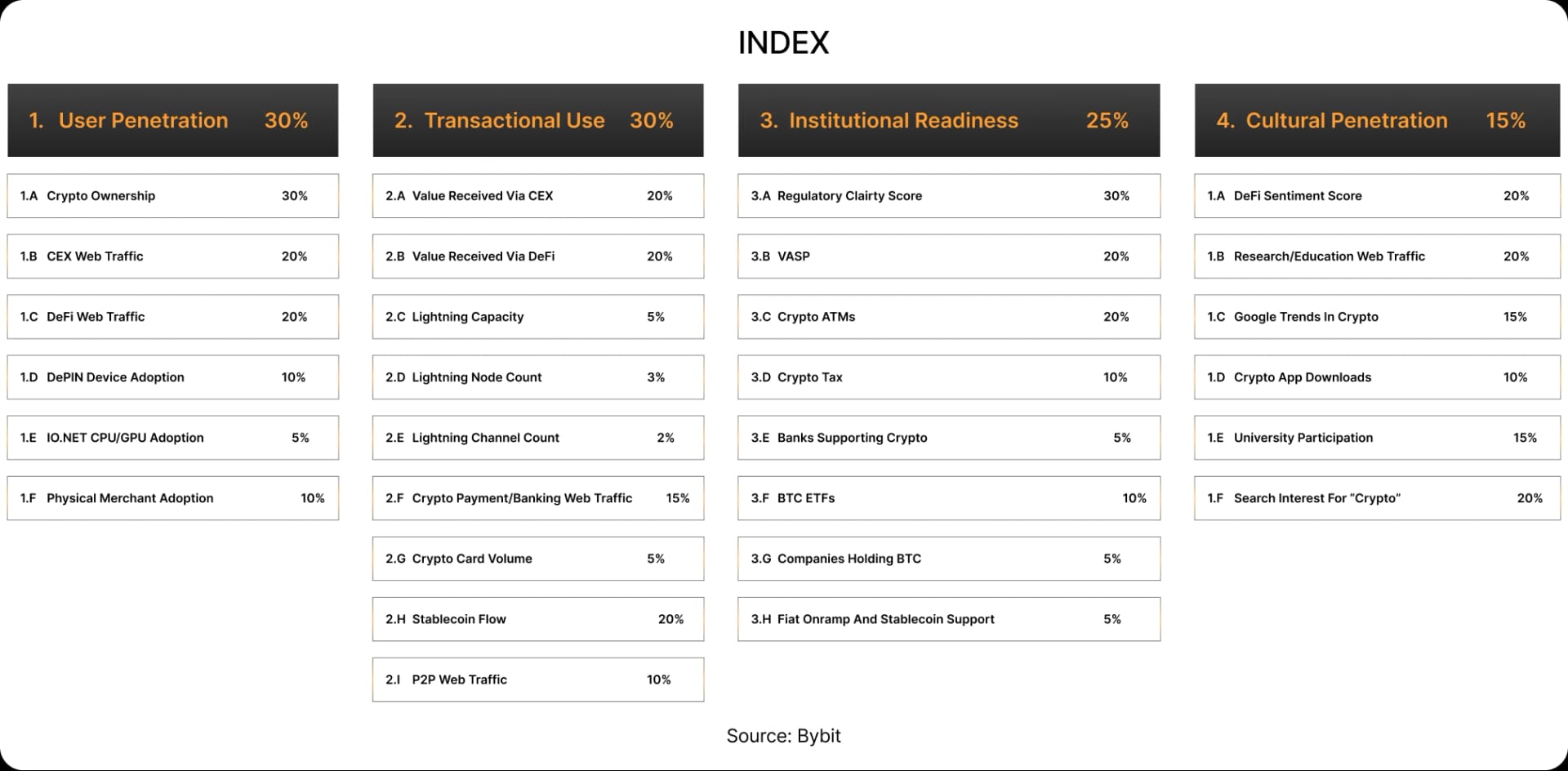
The Index is built on 28 metrics, representing 92 underlying data points per country, capturing both grassroots behaviour and institutional conditions to provide a balanced view of adoption. These metrics are organised across four pillars:
What the Index Measures
The Index is structured around four thematic pillars:
- Pillar 1 - User Penetration: Captures how deeply crypto has reached the population, from wallet ownership and exchange activity to merchant adoption and decentralised infrastructure.
- Pillar 2 - Transactional Use: Measures the degree to which crypto is part of everyday economic activity, including stablecoin flows, remittances, peer-to-peer trading, and crypto payments.
- Pillar 3 - Institutional Readiness: Reflects the policy and institutional environment, covering regulatory clarity, licensing frameworks, ETF approvals, and banking access.
- Pillar 4 - Cultural Penetration: Gauges public awareness and engagement, looking at search interest, app downloads, academic research, and education-related traffic.
Each pillar is scored on a 0-1 scale, where 1 represents the strongest global performer and 0 represents the weakest, with all other countries positioned in between.
The overall score is an average of the four pillars, weighted at 30% for User Penetration, 30% for Transactional Use, 25% for Institutional Readiness, and 15% for Cultural Penetration, and then converted into a 0-10 scale for readability.
As a matter of fact, the Index is best interpreted as a relative benchmark, not an absolute rating. The scores show how countries compare with one another, not a fixed level of adoption. Small differences in final scores (for example 6.2 versus 6.3), indicate broadly similar levels of adoption. Importantly, the Index is model-agnostic: countries with very different adoption profiles can arrive at comparable overall scores, as strengths in one pillar may offset weaknesses in another.
In this sense, the Index is best understood as a tool for identifying patterns and momentum. It highlights where adoption is strongest or weakest, shows which regions are moving fastest, and illustrates how different models, from institution-led hubs to necessity-driven markets, coexist in the global landscape.
For readers who want to explore the full technical details, including the complete list of metrics, weighting logic, and data sources, the full methodology is provided in the Appendix.
Insights and Trends
What the TOP Performers Tell Us
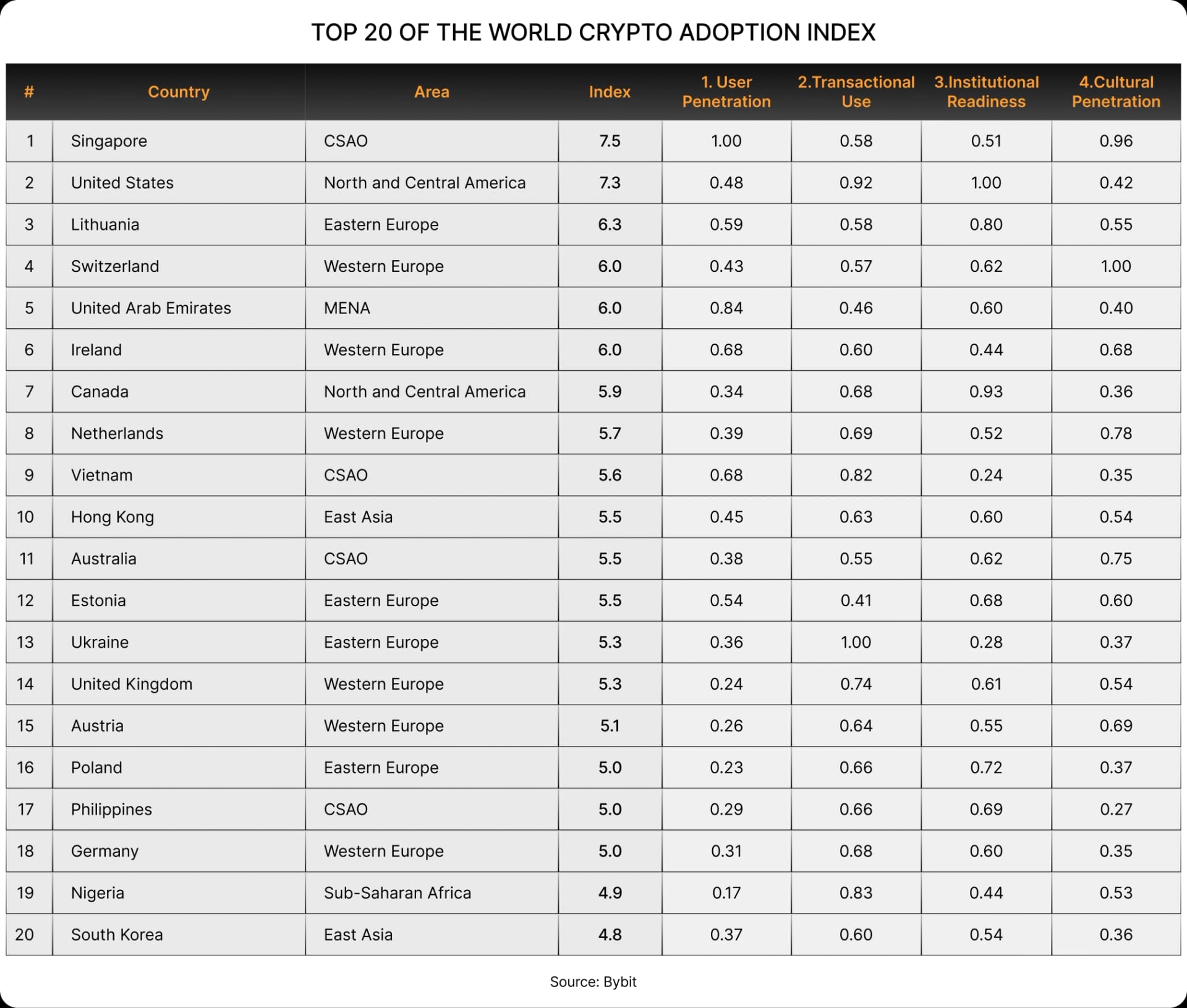
The Top 20 of the World Crypto Adoption Index highlights the varied pathways through which countries integrate digital assets. Leadership comes in different forms: advanced hubs embedding crypto into financial markets, smaller states amplifying their role through regulatory innovation, and necessity-driven economies where adoption accelerates through remittances, savings protection, or access to global tools. Together, these leaders show that there is no single model of adoption: crypto takes root wherever it provides meaningful solutions.
This section is divided into two layers. First, we draw out the broader insights that emerge from the Top 20 as a group, highlighting the structural and regional models that explain their positions. Second, we provide brief country spotlights that show how different combinations of user activity, institutional readiness, and cultural engagement have propelled these markets forward.
Note: Several of the countries listed in this section are explored further in the regional chapters, where their stories illustrate how global adoption continues to evolve.
Cross-Country Insights
Institutional Hubs at the Top
Institutional hubs dominate the upper tier of the rankings. Singapore (1), the United States (2), Lithuania (3), Switzerland (4), and the United Arab Emirates (5) all show how adoption flourishes when regulation, financial infrastructure, and institutional participation align.
Each follows a different model: Singapore leverages a digitally literate population and a clear licensing regime to attract both retail and institutional users, the U.S. anchors global liquidity through scale and ETF-driven institutional flows, Switzerland combines legal clarity with cultural embedding through Crypto Valley, and the UAE pairs ambitious policy frameworks with grassroots remittance-driven usage.
Together, they show that where institutions, infrastructure, and consumers reinforce one another, leadership consolidates.
Small European States Punching Above Their Weight
Lithuania (3), Estonia (12), Ireland (6), and Poland (16) highlight how small markets can achieve outsized influence when regulation and licensing regimes are strategically aligned.
Their modest populations mean domestic transaction volumes are limited, yet their frameworks attract exchanges and fintechs serving much larger markets. Lithuania and Estonia have become gateways into the EU, Ireland hosts major exchanges and payment firms, and Poland provides regional stability through EU-aligned oversight.
These cases confirm that regulatory agility can outweigh scale, turning small states into nodes of influence within the global crypto economy.
Necessity-Driven Outliers
A very different pathway is represented by Vietnam (9) , Nigeria (19), Ukraine (13), and the Philippines (17). Here, adoption is propelled less by institutional infrastructure than by practical necessity.
Crypto fills immediate financial needs: remittances, savings protection, inflation hedging, and peer-to-peer transfers. Vietnam’s high ownership rate, Nigeria’s reliance on stablecoins, Ukraine’s wartime use of crypto as a lifeline, and the Philippines’ remittance-driven flows all demonstrate how digital assets thrive where traditional systems are constrained.
These countries show that wealth and institutional maturity are not prerequisites for leadership when grassroots demand is strong.
Regional Pathways to Adoption
While the report explores each geography in detail later, the Top 20 itself reveals several insights that are worth highlighting here.
Europe
In Europe, small states such as Lithuania, Estonia, Ireland, and Poland illustrate the regulatory gateway model. By building advanced licensing regimes and clear oversight, they attract exchanges and service providers that operate across much larger markets.
Their scores highlight that Europe’s contribution to global adoption leadership comes less from large economies like Germany and more from specialised, digitally oriented states. This pattern also reflects a broader cultural reality: Europe’s larger economies remain relatively risk-averse toward crypto innovation, slowing the pace of retail and institutional adoption. However, this trend is beginning to shift, with countries such as Austria, the United Kingdom and the Netherlands demonstrating a greater openness to innovation and integration.
Switzerland is the notable exception, where openness to financial innovation and a strong tradition of tech experimentation have secured its place among the global leaders.
Asia
In Asia, two adoption archetypes coexist. Hub economies such as Singapore, Hong Kong, rely on policy clarity and institutional ecosystems to cement their status as global centres. Alongside them, grassroots markets such as Vietnam and the Philippines drive adoption from the bottom up, using crypto for remittances, savings, and decentralised applications.
Asia thus emerges as both a laboratory for institutional integration and a proving ground for financial inclusion.
North America
In North America, adoption is driven by institutional integration. The United States and Canada lead through ETFs, listed companies, and regulated access points that embed crypto within capital markets.
Their leadership demonstrates how financial maturity and scale translate into adoption when combined with regulatory milestones.
Other areas
Finally, Africa, the Caucasus, and Latin America are not yet strongly represented in the Top 20. The notable exception is Nigeria, which continues to thrive as one of the most active usage markets globally. High levels of peer-to-peer trading, reliance on stablecoins, and an evolving regulatory environment place Nigeria in the global leaders despite structural challenges. However, absence from the Top 20 does not imply a lack of activity. Countries such as Brazil and Argentina already show significant adoption dynamics. These markets, along with others in underrepresented regions, are explored in greater depth in the regional sections that follow.