




In traditional finance, unsecured lending powers trillions in consumer and business credit. Yet in DeFi, uncollateralised lending has long been considered too risky, too opaque, and too fragile to scale. After a wave of high-profile collapses in 2022, the sector nearly vanished.
Instead of disappearing entirely, however, uncollateralised lending is being quietly rebuilt. A new generation of protocols is rethinking how credit can work onchain, this time with a greater focus on transparency, modular design, and tighter risk controls.
This report explores the return of uncollateralised lending in DeFi. It examines the failures of earlier models, the evolution in protocol architecture, and how platforms like Wildcat and 3Jane offer early indications of a more sustainable approach.
Understanding uncollateralised lending
Uncollateralised lending is as old as money itself. In ancient Mesopotamia, farmers received grain and tools on credit before harvest, relying not by pledging assets but through trust and the promise of repayment. Lending functioned as a social contract, upheld by reputation and relationships rather than courts or collateral.
Today, the principle remains largely the same. Trust and informal enforcement still underpin the system. Fundamentally, uncollateralised lending allows borrowers to access capital without locking up assets. Instead of posting collateral, they rely on reputation, expected income, or off-chain verification to demonstrate creditworthiness. This model aims to free up capital and improve access to credit, especially for those who may lack significant onchain reserves but possess a strong ability to repay.
By contrast, collateralised lending requires borrowers to deposit assets that exceed the value of the loan. This structure secures lenders against default and remains the dominant model in DeFi today. The table below outlines the key differences between the two approaches:
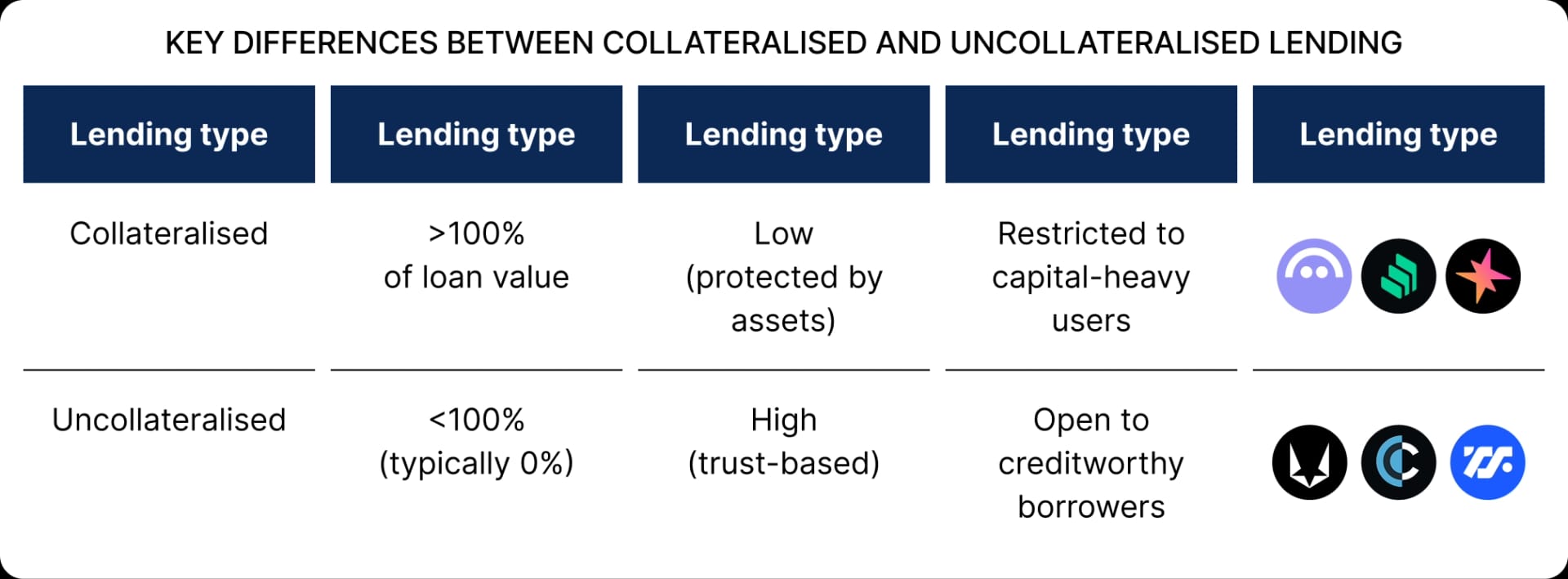
While collateralised lending dominates DeFi, traditional finance has long relied on uncollateralised models. Credit cards, student loans, and personal loans are commonly issued without security deposits. Lenders manage risk using credit scores, income verification, extensive underwriting and enforceable legal contracts. These tools are supported by stable identity systems and institutional enforcement.
DeFi lacks this infrastructure. Without legal contracts, identity frameworks, or credit histories, enforcement must be handled entirely by code. This limitation has made overcollateralisation the default mechanism: loans are secured not through legal recourse, but by requiring borrowers to deposit more than they borrow. Liquidation acts as a substitute for enforcement. While effective in reducing risk, this model restricts borrowing to those with existing capital and limits how capital can be allocated.
Uncollateralised lending offers an alternative. By removing collateral requirements, it enables capital to flow toward productive but asset-light users, such as businesses, active traders, or builders. The challenge lies in designing mechanisms that can assess credit risk, enforce repayment, and manage defaults without relying on traditional legal systems. In DeFi, this remains one of the hardest nuts to crack.
The size of the opportunity
Solving uncollateralised lending in DeFi may be one of the most difficult sectors to work in, but it is also one of the most overlooked opportunities.
The data highlights how underdeveloped this segment still is. The three largest uncollateralised DeFi protocols — Wildcat ($103M), Clearpool ($23M), and TrueFi ($8M) — currently support only $134 million in active loans.
In comparison, collateralised platforms like Aave, Morpho, and SparkLend manage $19.8 billion in active loans.
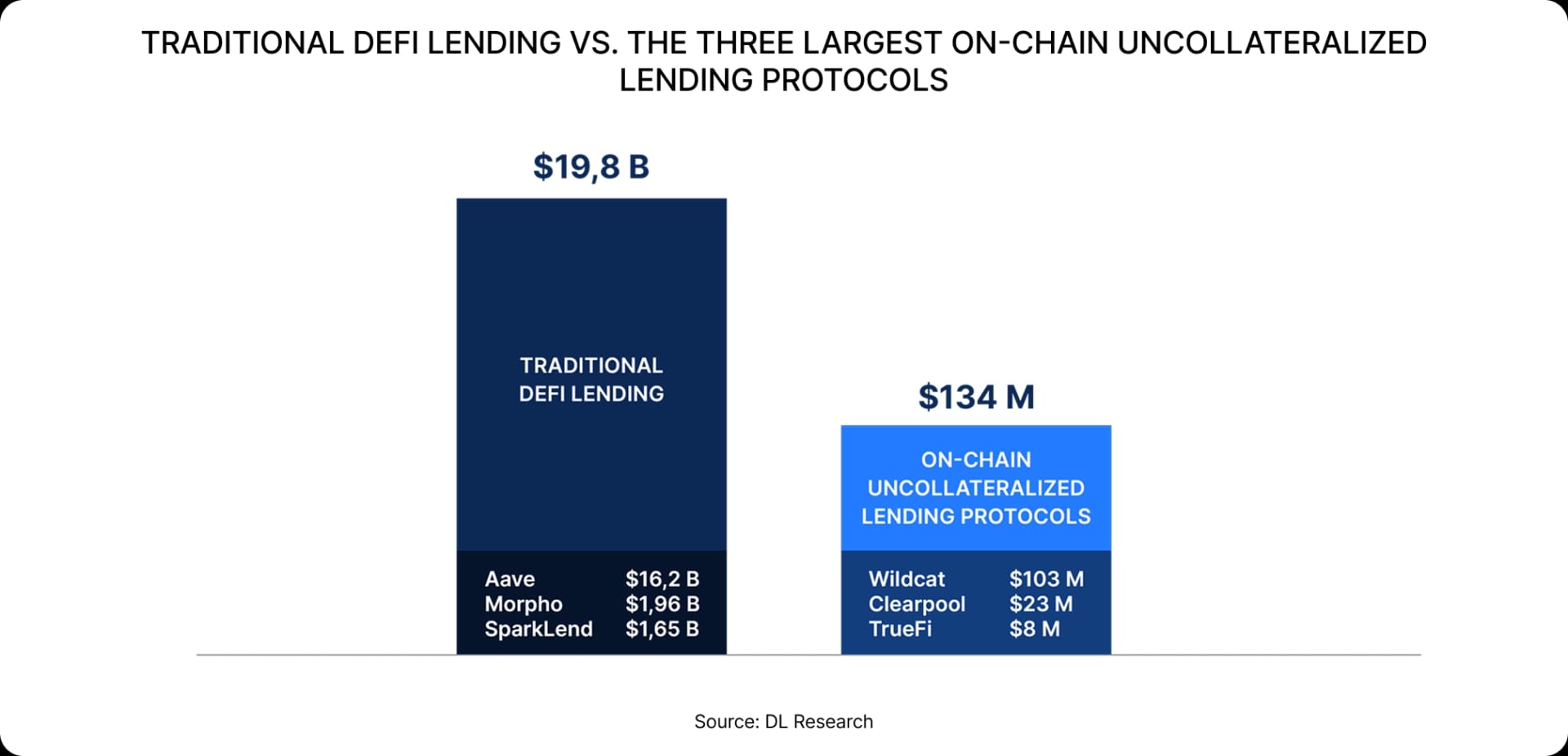
What makes this contrast even more striking is that the dynamic is completely reversed in traditional finance. Excluding mortgages, around 72% of consumer and business credit is unsecured. While traditional finance has matured with tools for pricing and enforcing credit risk, DeFi is still in the early stages. The two systems have developed in opposite directions, but they do not need to stay that way.
There is a clear and recurring demand for onchain credit. Market makers, trading firms, DAOs, and individual users frequently face capital needs that cannot be met through overcollateralised models alone.
Throughout multiple market cycles, we have seen periods where demand for uncollateralised lending surged, with billions of dollars borrowed onchain. What remains absent is a system that can meet this demand at scale without breaking under pressure.
This challenge goes beyond simply enabling lending. It requires designing infrastructure that can withstand the realities of DeFi, including volatility, global scale, and permissionless access, while still managing credit exposure, containing contagion risk, and maintaining transparency.
A system capable of doing so would not only compete with Aave or Compound, it would challenge the foundational mechanics of traditional finance itself.
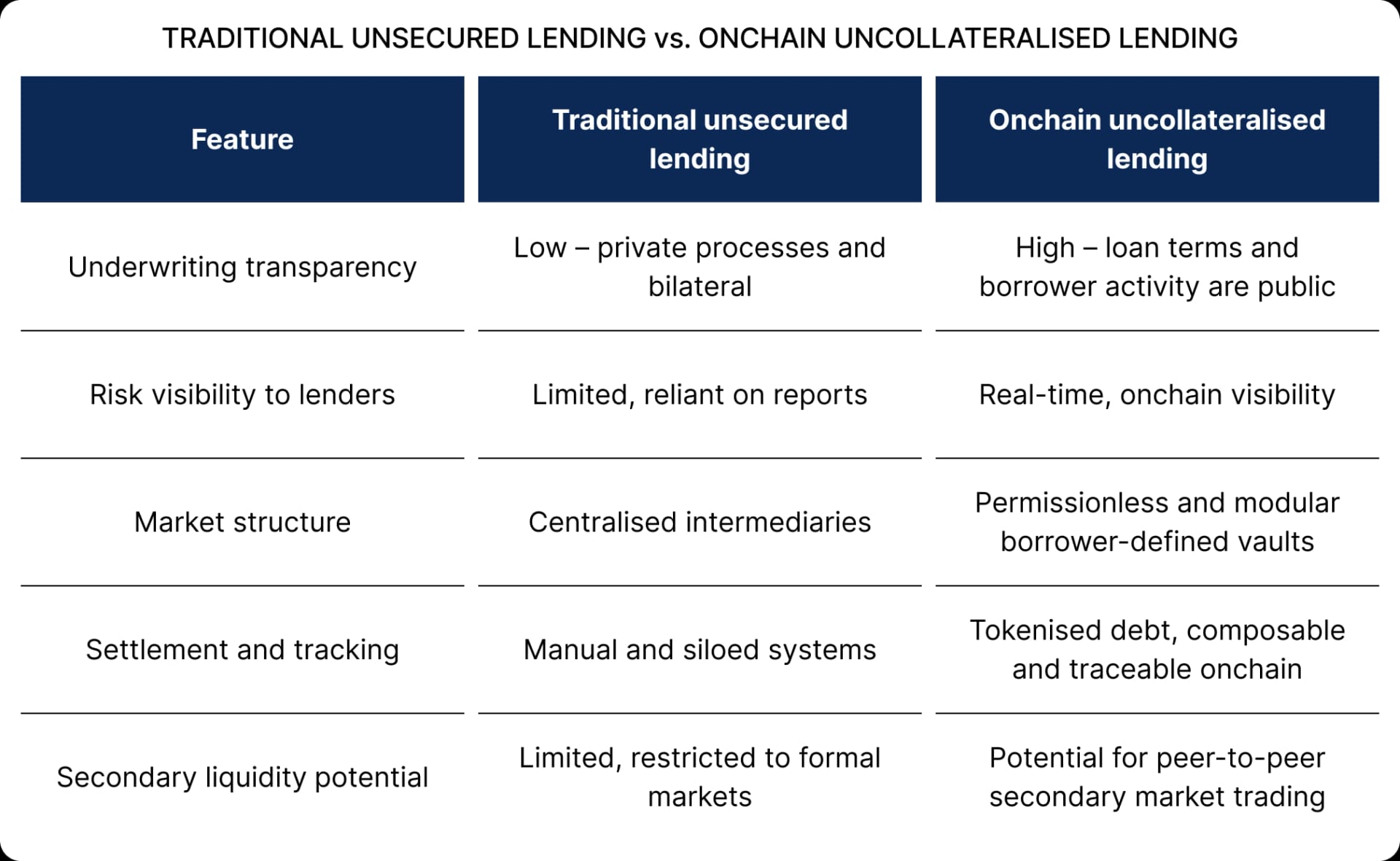
According to McKinsey, blockchain automation could save banks up to $1 billion annually in KYC compliance costs, reduce fines by $2 to $3 billion, and prevent between $7 and $9 billion in fraud- related losses. In 2023, a tokenised credit deal executed by BlockTower and Centrifuge demonstrated the cost-saving potential of onchain workflows, cutting securitisation expenses from approximately $400,000 to just $40,000 — a reduction of over 90%.
However, before DeFi can make any claims to transforming traditional credit, its protocols must first prove they can serve their own ecosystem. That means operating through volatility, surviving market cycles, and avoiding systemic risk.
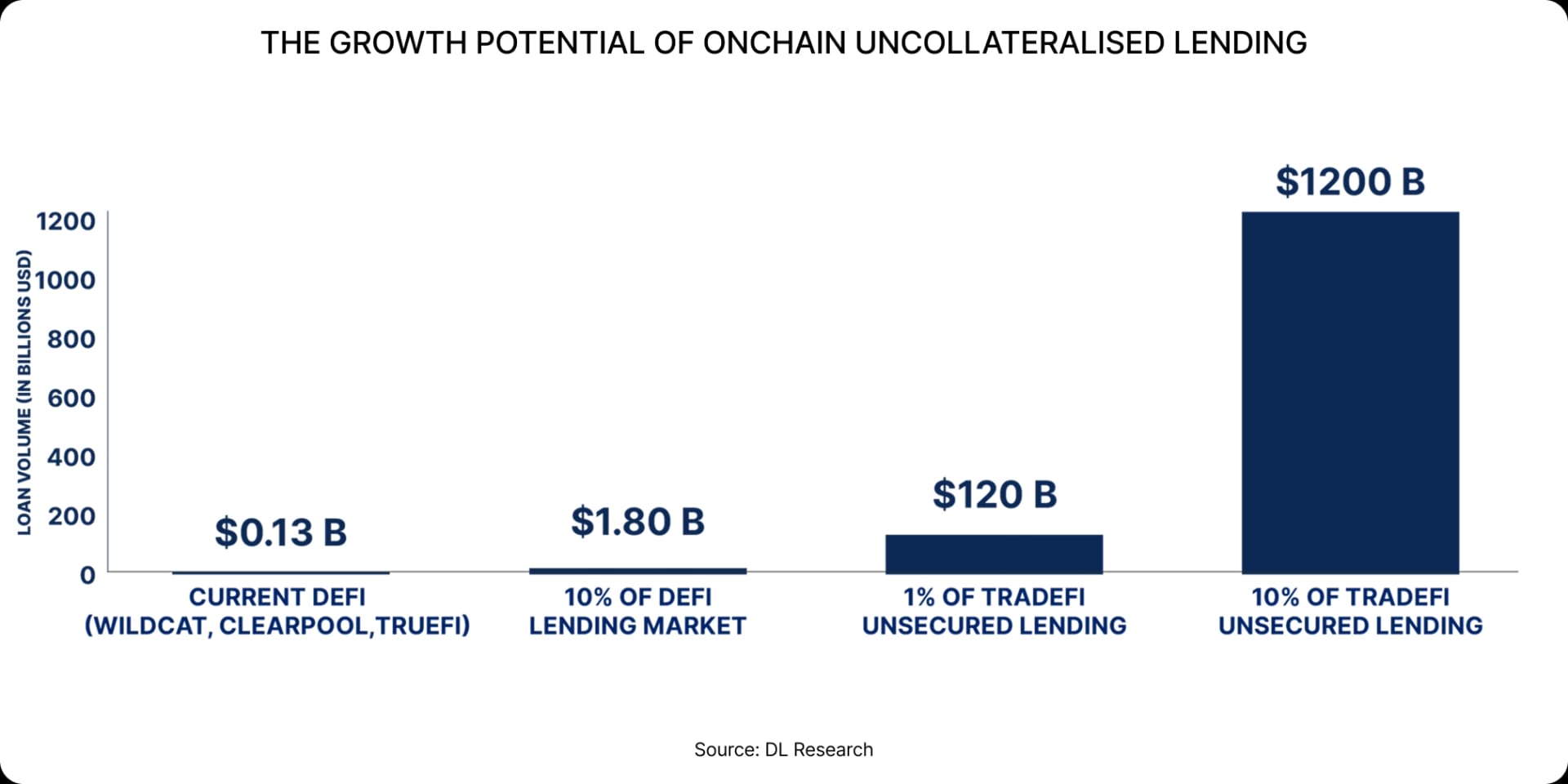
Even a modest breakthrough would be significant. Capturing just 10% of today’s DeFi lending market would translate to $1.8 billion in uncollateralised loans, which is over ten times the combined active loan volume of Wildcat, Clearpool, and TrueFi.
Looking further ahead, the opportunity expands significantly. A system capable of reliably supporting uncollateralised lending in crypto would also be well-positioned to serve traditional markets.
The global unsecured lending sector, excluding mortgages, is estimated to be valued between $12.5 and $15 trillion. Capturing just 1% of that market would mean $120 billion in volume. At 10%, it would exceed $1.2 trillion. For any protocol capable of operating at this scale, the opportunity is net positive.
What went wrong the first time
The opportunity for uncollateralised lending in crypto was not always seen as marginal. For a time, it was one of the most ambitious frontiers of the industry. By early 2022, the CeFi credit stack had grown to an estimated $35 billion in loan exposure across platforms such as Genesis, BlockFi, Celsius, and Voyager. Genesis alone managed a $14.6 billion loan book, highlighting the strong demand for these services.
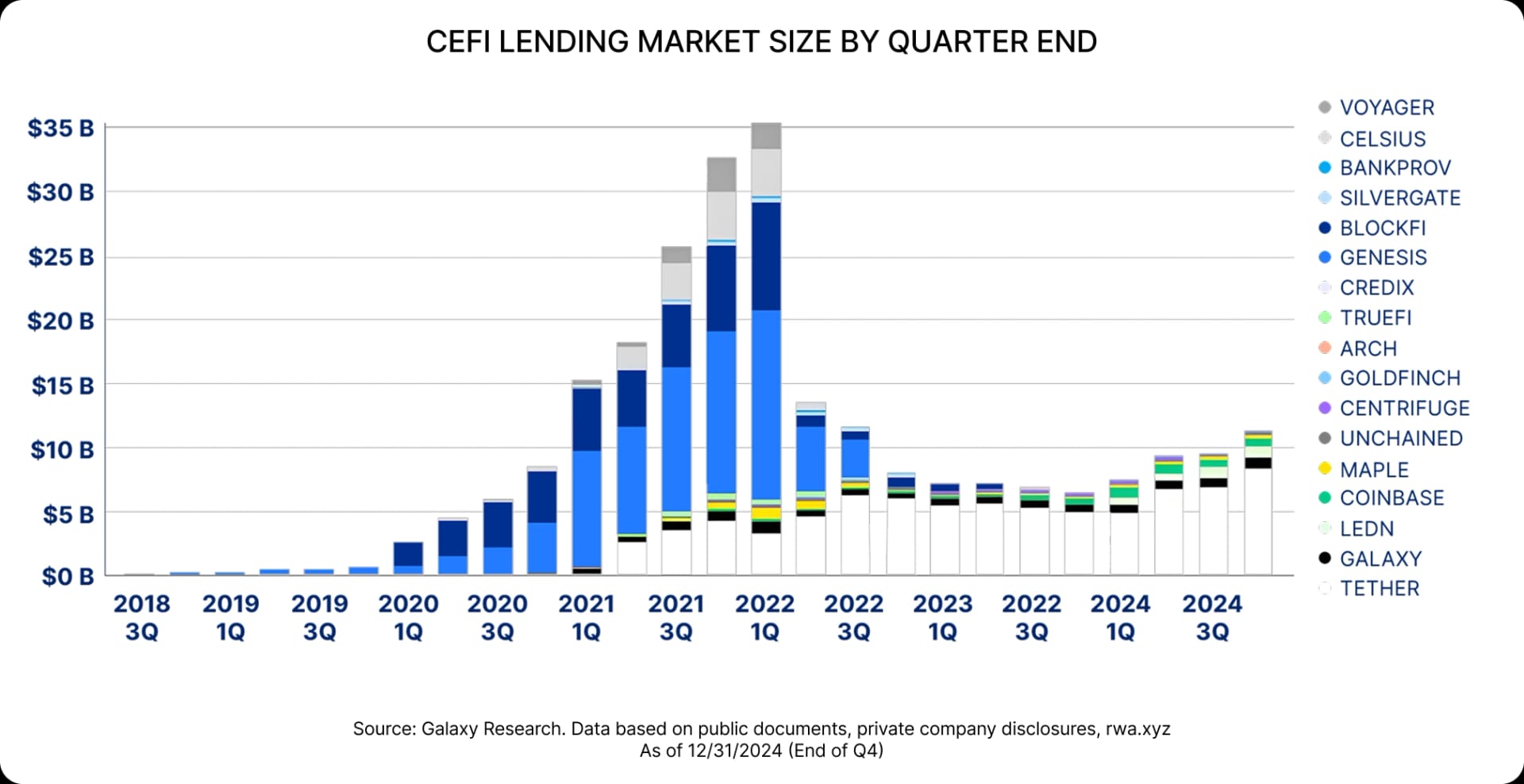
The problem, however, was that despite strong demand, the sector’s foundations were weak. It absorbed some of the worst practices from traditional finance and crypto without fully leveraging the underlying technology.
To understand how this has affected the uncollateralised lending space, we can examine three key failures from the first wave of companies and projects to see what went wrong.
Big contagion: Genesis, BlockFi, Celsius, Voyager
During the bull market from 2020 to early 2022, centralised lenders became foundational to the crypto industry. These platforms promised high-yield accounts to users, then recycled that capital into loans for hedge funds, institutional trading desks, and one another.
Genesis was the leading institutional credit desk, managing large volumes of bilateral loans and acting as a key counterparty across the market. Voyager and BlockFi positioned themselves as retail- friendly yield platforms, while Celsius marketed itself as a community-first alternative to traditional finance.
Although their public profiles differed, all four firms operated within a closed loop of crypto-native borrowers, often lending to the same counterparties. The system’s main vulnerability was its concentrated exposure.
Genesis had over $2.3 billion in active loans to Three Arrows Capital (3AC), the hedge fund that collapsed in mid-2022. Voyager had lent $935 million to 3AC, accounting for nearly its entire loan book. BlockFi had more than $1.2 billion in exposure to FTX and Alameda Research, which failed just a few months later.
The timeline below illustrates how one collapse triggered the next, setting off a rapid chain reaction across the lending ecosystem.

These were not failures of scale, but of structure. User funds were routinely rehypothecated without clear disclosure. Lending books were opaque, counterparties were heavily concentrated, and risk controls were often superficial. Perhaps the clearest illustration came in the form of a now-infamous AUM letter from Three Arrows Capital: a one-page Google Doc, signed by Kyle Davies, claiming a $2.387 billion NAV.
What seemed like a diversified sector was, in practice, a tightly interlinked system with little visibility into counterparty risk. With limited verification and few safeguards, a single default was enough to trigger widespread contagion.