




Solv Protocol: The Onchain Bitcoin Reserve
Bitcoin, the largest and most globally recognisable cryptocurrency, has seen meteoric growth, more than doubling in the past year. Spot ETFs largely fueled this surge, which facilitated over $35 billion in net purchases from traditional financial giants like BlackRock, Fidelity, and others. This, coupled with a crypto-friendly administration set to take office in the US, has sparked widespread discussion about Bitcoin’s role in institutional strategies.
The narrative of Bitcoin is also being reframed as an increasing number of companies start to recognise its value, incorporating BTC into their balance sheets as both a hedge against inflation and a potential growth asset. Beyond institutional and corporate interest, nations like the US and Russia are reportedly considering strategic Bitcoin reserves, while countries such as El Salvador and Bhutan have already taken steps toward adopting and even mining Bitcoin.
However, Bitcoin’s limited scripting capabilities have traditionally constrained its use in staking and advanced DeFi applications, leaving an estimated $1 trillion worth of BTC idle and underutilised.
Solv Protocol transforms Bitcoin from a static asset into an interoperable financial instrument. SolvBTC and SolvBTC.LST allow Bitcoin holders to use their assets seamlessly across multiple chains and protocols, much like wBTC or cbBTC. More importantly, the Staking Abstraction Layer (SAL) creates a “highway” for BTC to move freely between ecosystems. SAL enables holders to stake their Bitcoin and earn yield rather than simply letting it sit idle.
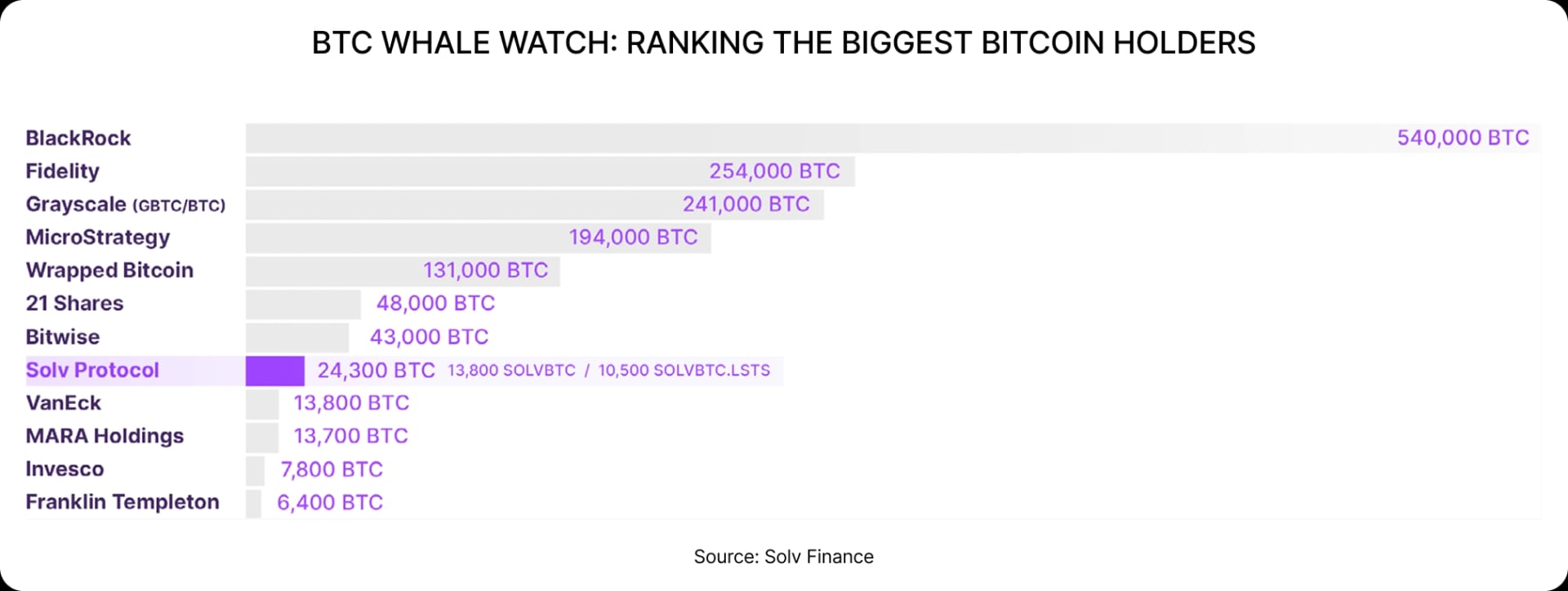
Ryan Chow, Founder of Solv Protocol, envisions the platform as an ‘onchain MicroStrategy.’ Instead of top-down institutional accumulation, Solv Protocol leverages its global community to amass and actively earn yield on a significant reserve of Bitcoin. By integrating with diverse protocols and chains, Solv Protocol aims to unify fragmented Bitcoin liquidity and create accessible pathways for Bitcoin holders to generate yield.
The results speak for themselves: Solv Protocol has already attracted a global user base of over 510,000, with 42,000 actively earning yield. More than 10,000 BTC are now in Solv’s Bitcoin reserve and an additional 15,000 as SolvBTC.LSTs, signalling its growing adoption and impact within the Bitcoin ecosystem.
The Team
Solv Protocol’s three co-founders collectively bring extensive experience in blockchain development, cryptography, and digital asset management.
Co-founder Ryan Chow focuses on enabling broader access to cryptocurrency investments, which led to the launch of Solv.
Co-CEO and co-founder Mike Yan (Yan MENG) is among the originators of the ERC-3525 token standard. His background includes roles as Deputy Director of the Chinese Institute of Digital Assets and senior manager in Strategic Communications at IBM, where he contributed to the rollout of blockchain strategies.
The third co-founder, known pseudonymously as Will42, also worked on the EIP-3525 proposal, introducing a ‘semi-fungible’ token model by combining properties of ERC-20 and ERC-721. Through its SLOT functionality, ERC-3525 reduces the need for multiple token contracts, supporting more flexible and customizable financial instruments in DeFi.
Solv has also received $23.8m in funding from a range of industry participants, including Blockchain Capital, Binance Labs, OKX Ventures, Laser Digital (Nomura Securities), UOB Venture Management, and Matrix Partners.
SolvBTC
SolvBTC acts as a unified reserve for native Bitcoin and other Wrapped Bitcoin products. The flexible, synchronous token is minted natively across ten different chains. This enables users to participate in DeFi while maintaining a strict 1:1 peg to their underlying BTC. The protocol incorporates a multi- layered system for custody, minting, and redemption, ensuring transparency, security, and utility.
The minting process consists of four steps:
- Users initiate the process in two distinct ways. Users either interact with smart contracts on EVM-based chains or deposit Bitcoin directly on the BTC mainnet. For EVM chains, users interact with minting contracts, which handle deposits of wrapped BTC assets (e.g., wBTC, BTCb, cbBTC). For the BTC mainnet, users deposit Bitcoin into designated addresses, with wallet management handled by a trusted custodian or a trustless cross-chain bridge, depending on the configuration.
- A light client or oracle system monitors the Bitcoin network to confirm transaction finality. It validates key details such as output scripts, block confirmations, and transaction integrity, ensuring deposits meet security requirements.
- If the deposit is directly on Bitcoin, a light client may be used on the destination chain to ensure trust-minimized verification of the Bitcoin transaction.If the deposit involves wrapped Bitcoin assets (e.g., WBTC), an oracle system may be used to relay deposit data from the custodial or wrapping service.
- Once verified, the Staking Abstraction Layer (SAL) generates a ‘deposit proof.’ This proof encapsulates critical data, including the depositor’s transaction, the amount of Bitcoin, and the recipient’s address on the destination chain.
- The deposit proof is relayed to the destination chain, where a minting smart contract verifies it against internal ledgers and reserve checks. After successful validation, the contract mints an equivalent amount of SolvBTC and assigns it to the user’s wallet.
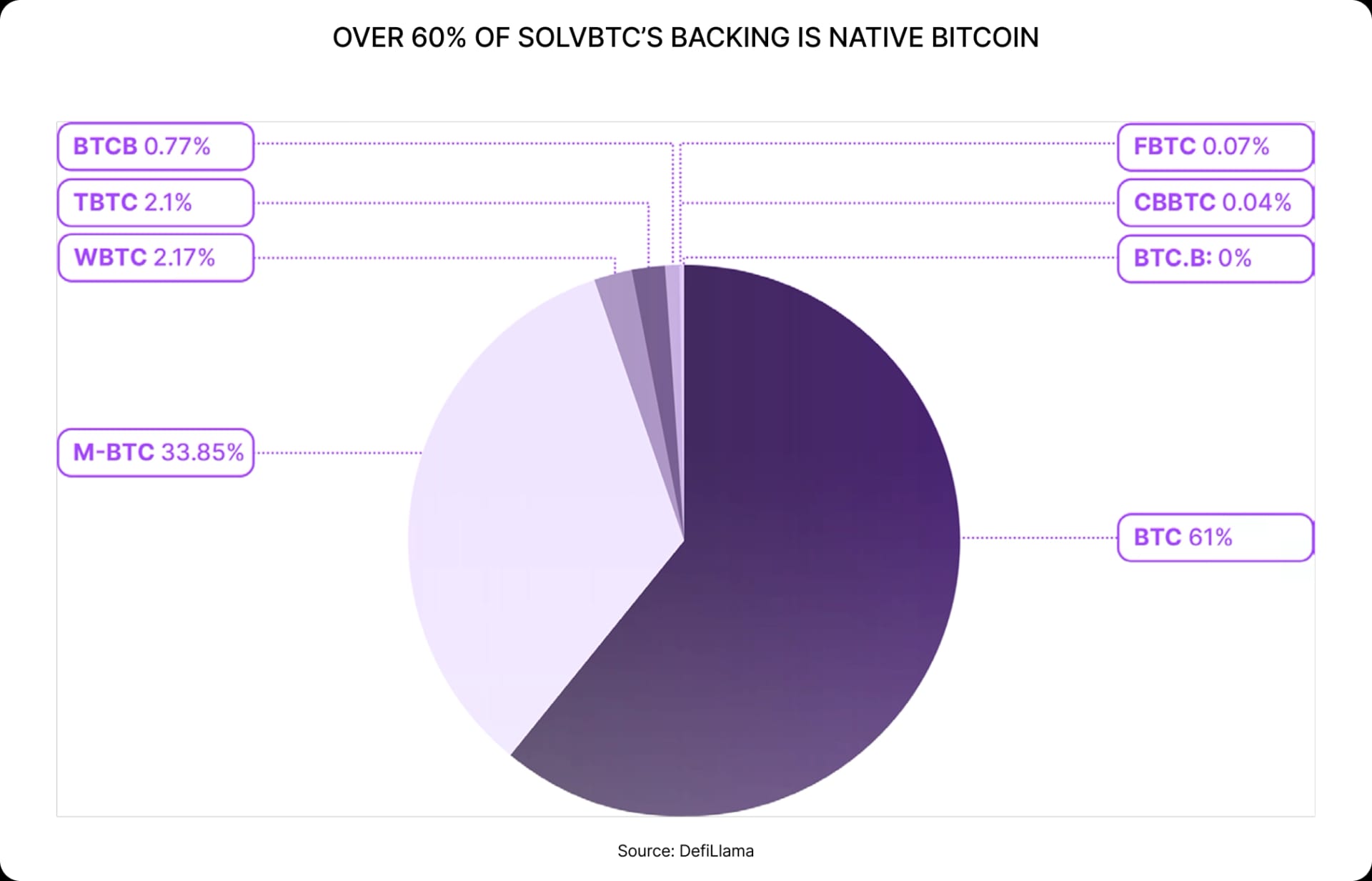
Every SolvBTC token is backed by an equivalent amount of BTC or recognised BTC-pegged assets securely locked within Solv Protocol’s custody. Although it is not yet live, Solv Protocol is working with Chainlink to build a comprehensive Proof-of-Reserves system. Until complete, users can verify the reserve assets using onchain data and cryptographic proofs, or using open-source data sites like DefiLlama.
Solv’s reserves consist of two asset categories: core reserves and innovative reserves.
Core Reserves
These include native BTC, BTCB (Binance’s wrapped Bitcoin), and cbBTC (Coinbase’s wrapped Bitcoin). Chosen for their resilience, broad adoption, and strong liquidity profiles, these assets form the cornerstone of SolvBTC’s value. Core Reserve Assets are exempt from minting caps or cross- chain rate limits.
Innovative Reserves
Innovative Reserves encompass newer or ecosystem-specific wrappers like wBTC, fBTC, BTC.b, and tBTC. Despite the potential for additional yield opportunities and broadening DeFi participation, they involve varying degrees of custodial and smart contract risk. To mitigate exposure, Solv Protocol imposes minting caps and cross-chain rate limits on these reserves. Governance by the SolvDAO will eventually decide adjustments to these parameters and determine whether any Innovative Reserves graduate to Core Reserve status.
Redemptions are processed through a queue, minimising liquidity risks during large withdrawals. Once sufficient liquidity is confirmed, the redemption token is burned and the corresponding Bitcoin is transferred to the user’s specified address. This mechanism ensures that the SolvBTC supply decreases proportionally, preserving its 1:1 peg. Built-in safeguards like time-delayed transactions and governance-based oversight further protect against system abuse.
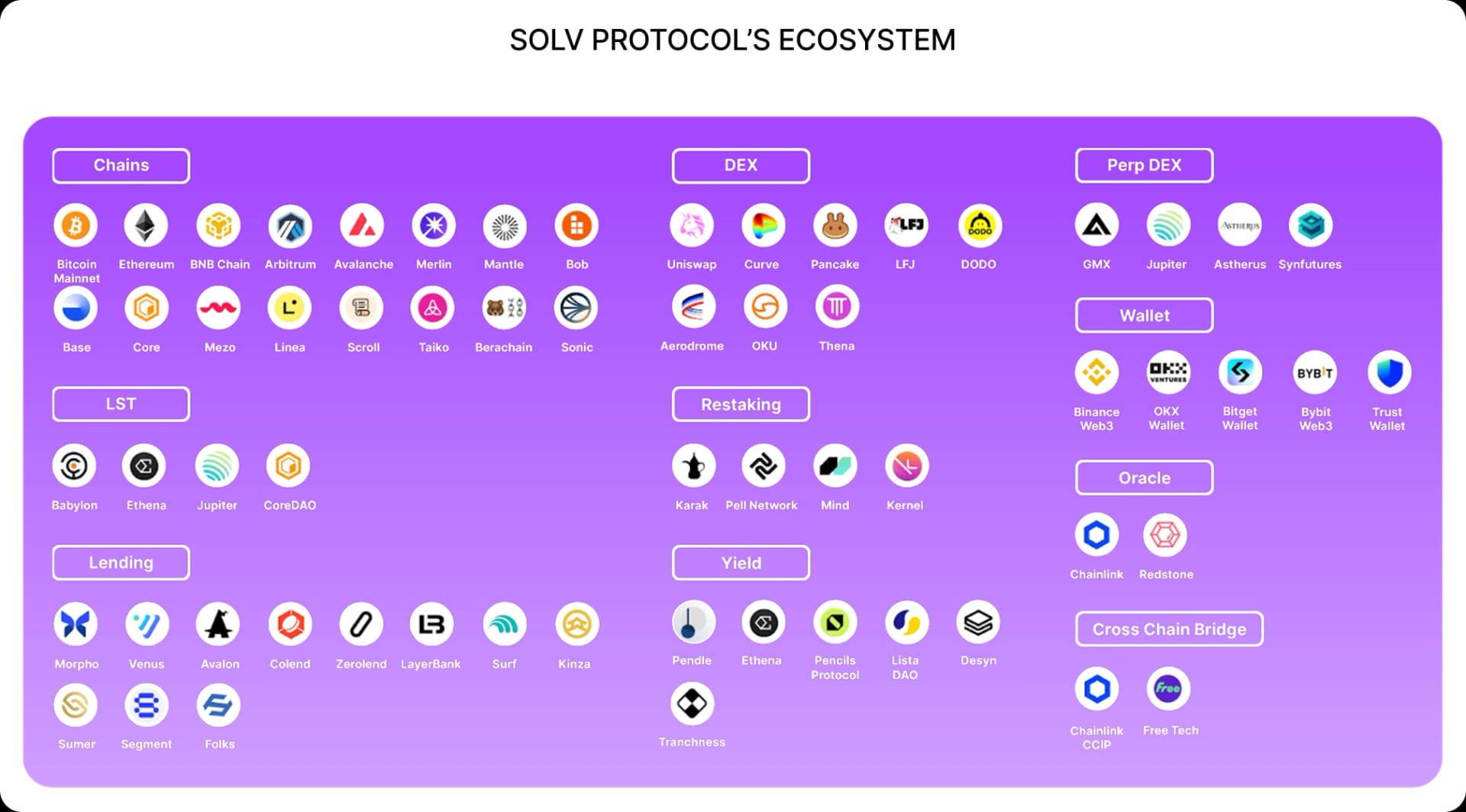
Popular DeFi protocols are increasingly integrating SolvBTC, offering users diverse opportunities to maximise their assets. For instance, it can be supplied on leading lending platforms like Venus and Morpho to earn yield or serve as collateral. Additionally, SolvBTC can be paired with other assets on prominent DEXs such as Uniswap, Curve, and Aerodrome, among others. As adoption grows, SolvBTC’s utility across the DeFi ecosystem continues to expand.
Staking Abstraction Layer
A crucial aspect of Bitcoin’s ongoing evolution is the ‘flywheel effect’ created by aligning traditional finance (TradFi), centralised finance (CeFi), and decentralised finance (DeFi) under one cohesive framework. As more institutions and investors integrate Bitcoin into established financial products, its legitimacy grows; when user-centric CeFi features simplify that integration, even more adoption follows. This rising momentum feeds directly into DeFi yield innovations, creating a self-reinforcing cycle that boosts liquidity, strengthens market confidence, and paves the way for wider Bitcoin adoption.
Solv Protocol is accelerating this flywheel dynamic. By offering integrations with legacy financial tools, intuitive staking services reminiscent of CeFi simplicity, and cutting-edge DeFi yield strategies, Solv transforms Bitcoin from a passive balance sheet holding into a fully interoperable, yield- generating financial instrument. While SolvBTC has been successful in its own right, the truly unique selling point of Solv Protocol is the Staking Abstraction Layer (SAL).
Diverse Yield Opportunities
One of SAL’s key innovations provides access to a wide range of yield streams. These include validator rewards on Proof-of-Stake (PoS) networks, restaking opportunities that compound returns, and delta-neutral strategies designed to hedge risk while maximising returns. By integrating Bitcoin into these yield-generating mechanisms, SAL transforms Bitcoin from a store of value into an active, yield-bearing asset.
Modular Architecture and Staking Abstraction Matrix
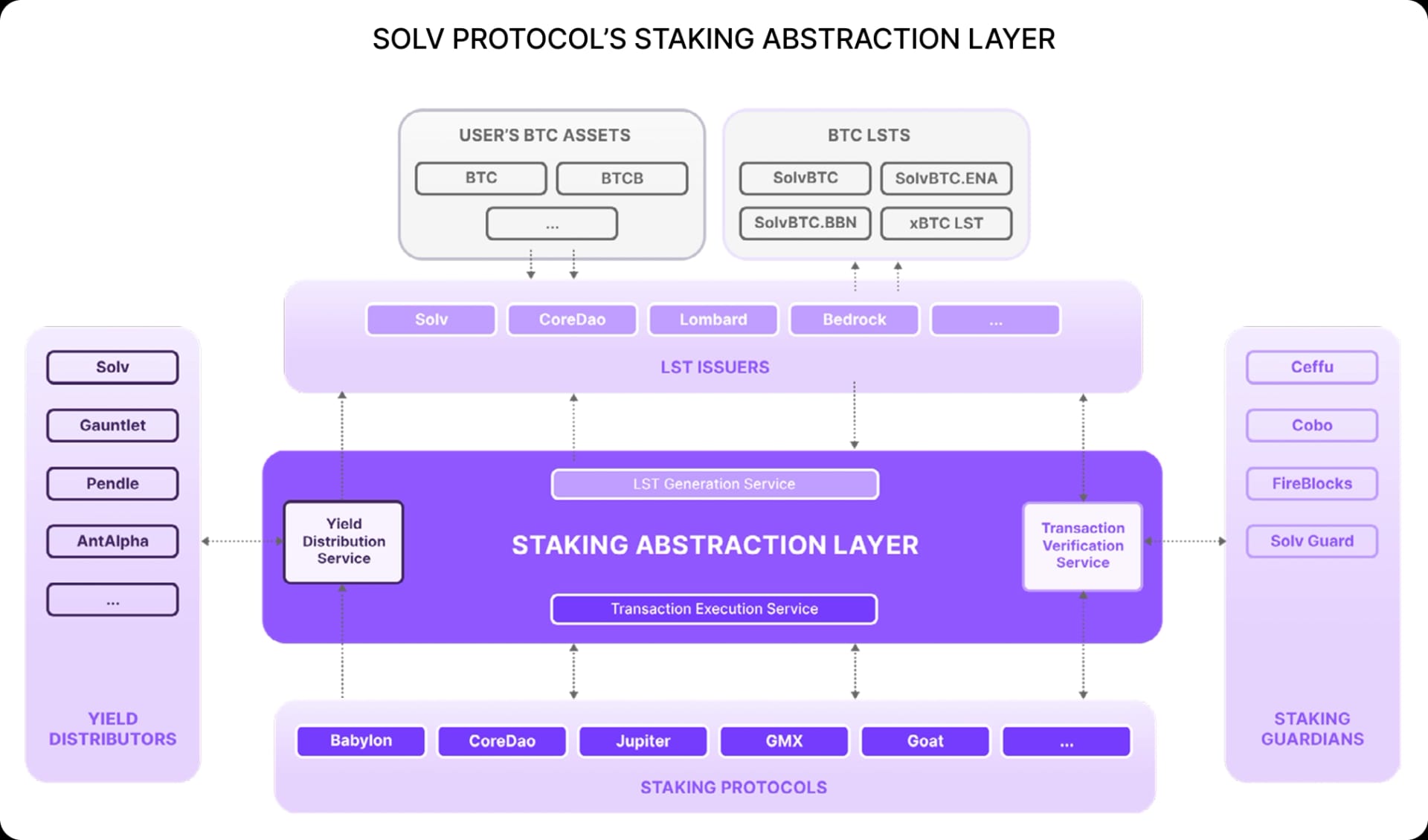
SAL’s modular design underpins its functionality, as the component plays a specific role in enabling staking operations. Central to this architecture is the Staking Abstraction Matrix (SAM), a comprehensive data model that standardises staking parameters, such as Bitcoin script configurations, transaction metadata, and reward distribution rules. This standardisation ensures consistency and interoperability across blockchains, allowing SAL to act as a bridge between diverse staking protocols.
Other critical modules include:
- LST Issuance Services mint liquid staking tokens that represent staked Bitcoin.
- Staking Verification Services validate transactions and ensure they align with user-defined configurations.
- Transaction Building Services automate the creation and submission of staking transactions to participating protocols.
- Yield Distribution Services ensure transparency and efficiency while managing the allocation and distribution of staking rewards.
The Staking Abstraction Layer represents a critical advancement in the usability and composability of Bitcoin within DeFi. By abstracting technical complexities and providing a unified staking framework, SAL enables Bitcoin holders to maximise their assets’ utility without sacrificing security or liquidity. SAL’s modular design, diverse yield opportunities, and focus on transparency and user control position it as a foundational layer for the next generation of Bitcoin-focused DeFi innovations.
SolvBTC.LSTs
SolvBTC’s liquid staking tokens (LSTs) unlock multiple avenues for Bitcoin holders to earn yield across diverse strategies and ecosystems. These strategies tap into different sources of yield generation, including restaking, validator rewards, and trading strategies.
Restaking Yields
Restaking protocols like Babylon, EigenLayer, and Symbiotic represent a cornerstone of SolvBTC’s yield-generation capabilities. These protocols leverage staked Bitcoin to secure additional networks or participate in decentralised consensus mechanisms, rewarding users with native tokens. For instance, SolvBTC.BBN, the protocol’s largest LST to date, has staked over 10,000 BTC, enabling users to earn Babylon staking yields, Babylon points, and Solv XP.
Validator Rewards
Validator networks such as CoreDAO, Stacks, Botanix, and Mezo offer real-yield opportunities for Bitcoin holders staking their assets. SolvBTC.CORE, one of the most active LSTs in this category, offers an annual percentage yield (APY) of 2-4% paid in CORE tokens, with seasonal incentives pushing APY up to 10% and early adopters earning as much as 50% APY during promotional phases. Validator-based yields offer a stable return for users while aligning with Bitcoin’s security and decentralisation ethos.
Trading Strategy Yields
Trading strategy-based yields offer another lucrative avenue, particularly in bullish market conditions. These strategies generate BTC-denominated returns, allowing users to ‘stack sats’ through innovative deployment. SolvBTC.Ethena, for instance, employs a basis trade where users collateralise Bitcoin, borrow stablecoins, and deposit them into Ethena to earn the staked USDe rate. This approach preserves Bitcoin exposure while unlocking additional yield streams. Similarly, SolvBTC. JUP taps into Jupiter’s liquidity pool (JLP) to deliver returns from trading fees. During bull markets, JLP yields have exceeded 60%, with Solv Protocol hedging open interest on centralised exchanges to stabilise returns.
Bridging and Cross-Chain Expansion
SolvBTC’s flexibility extends to its integration across multiple chains. Chainlink’s Cross-Chain Interoperability Protocol (CCIP) supports transfers across Base, Avalanche, Arbitrum, Ethereum, BNB Chain, and Linea. Complementing this, Free.tech bridges support even more ecosystems, including newer chains like Scroll and Sonic. Initially, Solv employed a lock-and-mint bridging model with Free. tech. However, it has transitioned to a burn-and-mint framework to eliminate risks of double-counting and ensure accurate supply accounting.
As the protocol expands, new integrations with bridging solutions such as LayerZero and Wormhole are expected to bring SolvBTC to additional chains. These advancements align with the protocol’s commitment to enhancing accessibility and liquidity for Bitcoin holders, enabling seamless movement and deployment of assets across ecosystems.
Onchain Microstrategy?
Michael Saylor’s transformation of MicroStrategy into a major Bitcoin holder exemplifies how corporate treasuries can leverage BTC for both capital appreciation and brand visibility. By raising nearly $20bn through convertible bond and equity sales, MicroStrategy acquired over 2% of Bitcoin’s total supply – an investment that propelled the firm’s stock price more than 400% in 2024. Though widely regarded as visionary, Saylor’s top-down, debt-fueled strategy entails significant leverage, exposing the company to potential volatility if Bitcoin’s price retreats.
Solv Protocol’s co-founder, Ryan Chow, seeks to replicate this success onchain, calling his initiative the ‘first-ever Onchain MicroStrategy.’ Rather than relying on a single corporate balance sheet, Solv Protocol aggregates BTC from multiple participants, issuing SolvBTC — a multi-chain, yield-capable representation — rather than letting Bitcoin lie dormant. By tapping into DeFi and permissionless liquidity, Solv aims to democratise what Saylor accomplished, enabling a wider pool of users to benefit from Bitcoin-based yield while preserving BTC exposure.
Although more than 10,000 BTC have been deposited into SolvBTC, the protocol lags behind MicroStrategy’s scale, which sits above 2% of Bitcoin’s total supply. Continued growth of reserves will likely signal institutional and retail confidence, particularly if Solv consistently provides stable yields.
Securing broad adoption in DeFi is similarly crucial. Just as MicroStrategy’s stock acts as a BTC proxy in traditional markets, SolvBTC must gain traction on decentralised exchanges and lending platforms to entrench itself in the crypto ecosystem. This will require transparent governance, a robust proof-of-reserve model, and strong security measures to mitigate any concerns about de-pegging or mismanagement.
Download the full report here
Download the "Solv Protocol: The Onchain Bitcoin Reserve" report here(PDF)