




Understanding DeFi risk
Why risk matters in DeFi
DeFi is redefining the foundations of global finance. Replacing the current financial system – by introducing new forms of lending, staking, trading, liquidity provisioning, and yield generation – with programmable protocols enables borderless, trust-minimised access to financial opportunities. However, the proliferation of open-source innovation also presents significant risks. Investors face exposure to smart contract vulnerabilities, oracle risks, liquidity constraints, and stablecoin instability. A lack of centralised institutions forces individuals to carefully navigate a fragmented ecosystem of interconnected protocols, many of which rely on rapidly evolving technical infrastructure.
Market volatility can further compound these risks. Many protocols rely on crypto-denominated collateral that can swing dramatically in price, quickly triggering liquidations, collateral shortfalls, or incentive misalignments. Meanwhile, protocol-level failures ranging from unaudited (and even audited) smart contracts, flawed tokenomics, or governance attacks expose even the most experienced investors to variable levels of onchain risk.
The growing complexity of DeFi risks
Risk management has become a critical infrastructure for security and helps preserve investor capital. As new blockchains, protocols, and yield-bearing strategies continue to emerge, the complexity and risk surface of DeFi grows mainly due to the composability of DeFi and interdependency risks. Speculative incentives, such as airdrop farming, often drive this momentum. This has lured users into nascent, lightly tested protocols with the promise of outsized yields.
In an industry where innovation often outpaces education, it’s more important than ever for users to leverage tools that can surface, contextualise, and quantify risk. These tools empower investors to navigate DeFi safely and with confidence.
What DeFi exploits teach us about risk
Despite DeFi’s promise of open, composable finance, its rapid pace of innovation often exposes hidden vulnerabilities. Major exploits ranging from Bybit’s recent $1.5B custodial breach to Mango Markets’ oracle manipulation reveal how protocol design flaws, centralised key management, and misaligned incentives can trigger catastrophic losses. Even well-audited systems like Euler Finance were compromised through nuanced flash loan mechanics. Even cross-chain bridges such as Ronin and Wormhole demonstrated how validator coordination lapses and multisig failures can undermine a decentralisation approach.
Stablecoins and their alternatives have also proven fragile under volatility. Terra’s algorithmic UST collapse and USDC’s temporary depeg in March 2023 illustrated how promising products and offchain banking exposure can fracture even the most integrated ecosystems. These incidents reinforce that smart contracts are only part of the equation, while mechanism design, infrastructure dependencies, and real-time monitoring are just as critical.
Standardising risk in DeFi
In traditional finance, credit rating agencies like Moody’s, Fitch, and S&P are pivotal, helping investors understand the risks associated with bonds and companies. Their standardised methodologies allow investors to assess risk-adjusted returns and make more informed portfolio decisions. As DeFi grows in complexity, it faces a similar need: a consistent, credible, and widely understood risk standard.
The yield opportunities in DeFi are abundant, as are the risks, ranging from smart contract vulnerabilities and governance centralisation to liquidity and oracle risks. Without a consistent benchmark to evaluate these risks across protocols and asset types, investors are left blindly navigating a fragmented ecosystem. As in traditional markets, a shared standard around risk is essential to price assets effectively, allocate capital more responsibly, and grow investor confidence.
A meaningful risk standard must meet three key requirements:
- Fact-based: Assessments must be grounded in objective, verifiable data. This includes protocol audits, economic design, historical performance, and security track records.
- Holistic: Risk cannot be siloed. A complete evaluation must span all major risk types, from the chain infrastructure and protocol design to the behavior of underlying assets and the mechanics of individual pools.
- Standardised across assets and protocols: A usable framework must be consistently applied across the DeFi landscape. This enables fair comparisons, improves transparency, and helps users align yield opportunities with their individual risk tolerances. A scorecard approach ensures repeatability and scalability as new protocols and strategies emerge.
Exponential’s risk methodology was built to meet these requirements. In response to the growing complexity and opacity of DeFi, the platform introduces a transparent, data-driven risk framework that empowers investors to navigate DeFi safely and confidently.
Much like traditional credit ratings, Exponential’s ratings distil technical and financial data into intuitive, letter-grade risk scores (A-F). Its methodology evaluates four major dimensions of risk:
- Chain risk: Evaluating the reliability, decentralisation, and maturity of the underlying blockchain.
- Protocol risk: Assessing the smart contract design, governance structure, and security posture of the protocol.
- Asset risk: Examining collateral quality, peg mechanisms, volatility, and other asset-specific traits.
- Pool risk: Measuring risks specific to the individual strategy, including leverage, complexity, and dependency on external integrations.
This holistic, standardised scorecard enables investors to distinguish between sustainable and speculative yield, apply consistent risk filters to new opportunities, and construct portfolios aligned with their goals. Whether comparing single-asset staking products or complex multi-strategy vaults, this risk framework delivers a practical, scalable way to bring transparency and structure to DeFi investing.
As DeFi continues to expand across new chains, protocols, and investor profiles, this type of standardised risk evaluation will become the foundational infrastructure to support smarter investment decisions and help the ecosystem mature.
Structured products in DeFi: An overview
Structured products: Simplified returns, compounded risks
Risk management is especially critical in structured DeFi products, where multiple yield strategy products such as staking, lending, and liquidity provisioning are conveniently bundled into a single vault. While these structured products are designed to simplify access to optimised strategies, they also obscure complexity. Risks can then be compounded across integrated protocols, smart contracts, and external dependencies, making risk management more difficult to manage.
Despite these complexities, many investors continue to evaluate yield opportunities based solely on promoted yields. Without transparent risk breakdowns, users often conflate short-term returns with sustainable yield, mistaking protocol rewards for real yield. As a result, investment decisions are frequently driven by surface-level metrics rather than a holistic understanding of risk exposure.
From token incentives to sustainable yield
The evolution of yield generation in DeFi mirrors the space’s broader transition from experimental incentive schemes to more sophisticated, sustainable financial engineering. In its earliest days, inflationary governance token emissions drove DeFi yield. Protocols like Compound, Synthetix, and Yearn incentivised participation with freshly minted tokens that users could farm and sell. This era gave rise to mercenary capital, liquidity that flowed short-term between protocols to capture incentives, often with little regard for protocol longevity. While this model rapidly attracted capital and bootstrapped user activity, it was ultimately unsustainable, as yields depended on token inflation rather than real cryptoeconomic activity. The ‘DeFi Summer’ of 2020 exemplified this trend, where users flocked to triple-digit APYs without fully understanding the risks or circular nature of many tokenomics models.
Structured products: The mechanics of modern DeFi
As the crypto markets matured, yield strategies began to align more closely with real economic drivers, such as lending interest (e.g., Aave), trading fees from LPs (e.g., Uniswap), or staking rewards. These mechanisms were more closely tied to actual user activity and protocol utility, which was viewed as more sustainable over time. However, even with these developments, users were tasked with managing the underlying complexities of selecting assets, timing positions, monitoring volatility, and assessing an array of smart contract risks. This burden led to the rise of structured DeFi products, which abstract complexity by offering curated, passive access to yield-generating strategies.
In DeFi, structured products refer to vault-based instruments and strategy aggregators that programmatically allocate user capital across multiple yield sources. These products may include combinations of staking derivatives, lending markets, liquidity provisions, perps, and/or options bundled into a single structured product. For example, Yearn Finance pioneered yield aggregation by routing stablecoin deposits through the most profitable lending protocols, while more recent platforms like Pendle offer products that split principal and yield.
In each case, the objective is to automate yield optimisation and minimise investor intervention.
Classifying structured products in DeFi
Structured products can be classified into the following categories:
- Yield aggregators (e.g., Yearn) focus on maximising return by routing deposits to yield-generating sources
- Leveraged yield vaults (e.g., Gearbox) use borrowing to amplify returns but also expose users to liquidation and interest rate risk
- Option-based vaults (e.g., Ribbon Finance) generate yield by selling options against deposited assets, capturing premium but assuming directional risk
- Structured Lending (e.g., Notional Finance) splits yield into principal and yield tokens, enabling fixed-income products
Compared to direct staking or simple LP positions, these products offer more upside. However, this abstraction introduces additional risks, including smart contract risks, reliance on strategist execution, and asset correlation across protocols, making clear risk evaluation that much more important.
How market trends have shaped risk awareness
From a historical lens, DeFi’s structured product ecosystem has evolved significantly since 2021. The initial proliferation of yield aggregators was driven by the need to simplify farming strategies. As gas costs rose and multichain ecosystems emerged, protocols began offering cross-chain vaults, whitelisted strategist programs, and auto-compounding mechanisms. In parallel, the collapse of protocols like Terra and high-profile DeFi exploits have made users more cautious, prompting demand for products that balance sustainable yield and risk management to preserve capital.
This brings us to the case studies ahead, where we examine three distinct structured DeFi products. Each showcases a strategic approach to yield generation and reinforces the importance of applying a practical, data-driven risk framework to evaluate these products.
Case studies: Three structured products
This section offers an in-depth analysis of three structured DeFi products, examining their design, yield generation mechanics, and strategies. Each case study is followed by Exponential’s risk assessment, providing a clear lens through which to evaluate the product’s risk-return profile.
Superform’s SuperUSDC vault
Overview: SuperVaults and the SuperUSDC strategy
SuperVaults are Superform’s flagship onchain yield product, engineered to deliver optimised stablecoin returns while abstracting away the complexities of DeFi. The inaugural vault, SuperUSDC, launched on Ethereum and provides automated access to high-performing USDC yield strategies across a curated set of whitelisted protocols. Built atop Yearn v3’s battle-tested framework and integrated with Superform’s core infrastructure, the vault design has been audited by yAudit.
Designed without leverage, SuperVaults prioritise stable, predictable returns through slippage- free rebalancing, reallocating capital in real time based on strategy performance. This vault offers a streamlined, automated experience for passive investors seeking competitive yields.
SuperVault’s mechanism design
Deposit flow and protocol allocation
When a user deposits USDC into the SuperUSDC vault, the transaction is routed through the SuperformRouter, determining the optimal vault and yield route. This router sends capital to a curated vault managed by Superform, where assets are programmatically allocated across high-performing, whitelisted DeFi lending protocols such as Morpho, Euler, Aave, and Fluid.
Upon deposit, users receive SuperPositions (SPs), tokenised representations of their share of the vault’s underlying strategy. These SuperPositions are minted using the ERC-4626 token standard, which standardises yield-bearing vaults and ensures broad interoperability across the DeFi ecosystem. Superform also supports ERC-7540, a newer token standard designed for multi-vault tokenised positions, enabling structured products to span multiple chains and strategies with greater efficiency. This enhances composability and allows vaults to span multiple strategies or chains efficiently.
As yield is generated from the underlying protocols, it accrues in the vault, automatically increasing the value of users’ SuperPositions over time.
Underlying yield strategies
Once deposited capital is allocated across protocols, the SuperUSDC vault earns yield through three primary mechanisms:
- Lending markets (e.g., Aave, Morpho, Euler): These protocols generate interest from overcollateralised borrowers. Yields here are a function of borrowing demand. During periods of growing leverage demand, such as bull markets, borrowers drive up utilisation rates and interest rates. Conversely, in bear markets or risk-off environments, reduced borrowing leads to muted returns.
- Protocol incentives (e.g., Euler rewards): Some integrated strategies rely on emissions or incentive programs. While these can temporarily boost APYs, they are less durable and subject to governance or emissions schedule changes.
Each yield source is continuously evaluated through Superform’s rebalancing logic, which dynamically reallocates deposits toward the most competitive and risk-adjusted strategies.
Rebalancing logic and yield optimisation
To maintain risk-adjusted returns and optimise during market shifts, SuperVaults employs an automated rebalancing engine. This engine uses predictive metrics, such as SuperAPY (a forward- looking yield estimator) and Sharpe ratios (a volatility-adjusted return measure) to evaluate the relative performance and risk profile of each yield source.
A Keeper contract continuously monitors yield sources and initiates a rebalance when:
- More favorable APYs become available on alternative protocols
- Risk thresholds are exceeded
- Market inefficiencies or liquidity changes trigger reallocation
The Keeper contract triggers reallocation through the SuperformRouterWrapper, which executes capital transitions with minimal slippage and gas overhead. Because vaults are non leveraged, transitions remain predictable and within conservative risk boundaries.
This real-time optimization allows SuperVaults to dynamically shift between strategies without manual intervention, offering a “set-and-forget” experience for users.
Vault performance: Ethereum vs. Base
Since its launch, SuperUSDC has delivered competitive and reliable yields by dynamically reallocating capital across integrated DeFi protocols. Available on both Ethereum and Base, the vaults follow similar strategies but offer different tradeoffs in cost, liquidity, and ecosystem maturity.
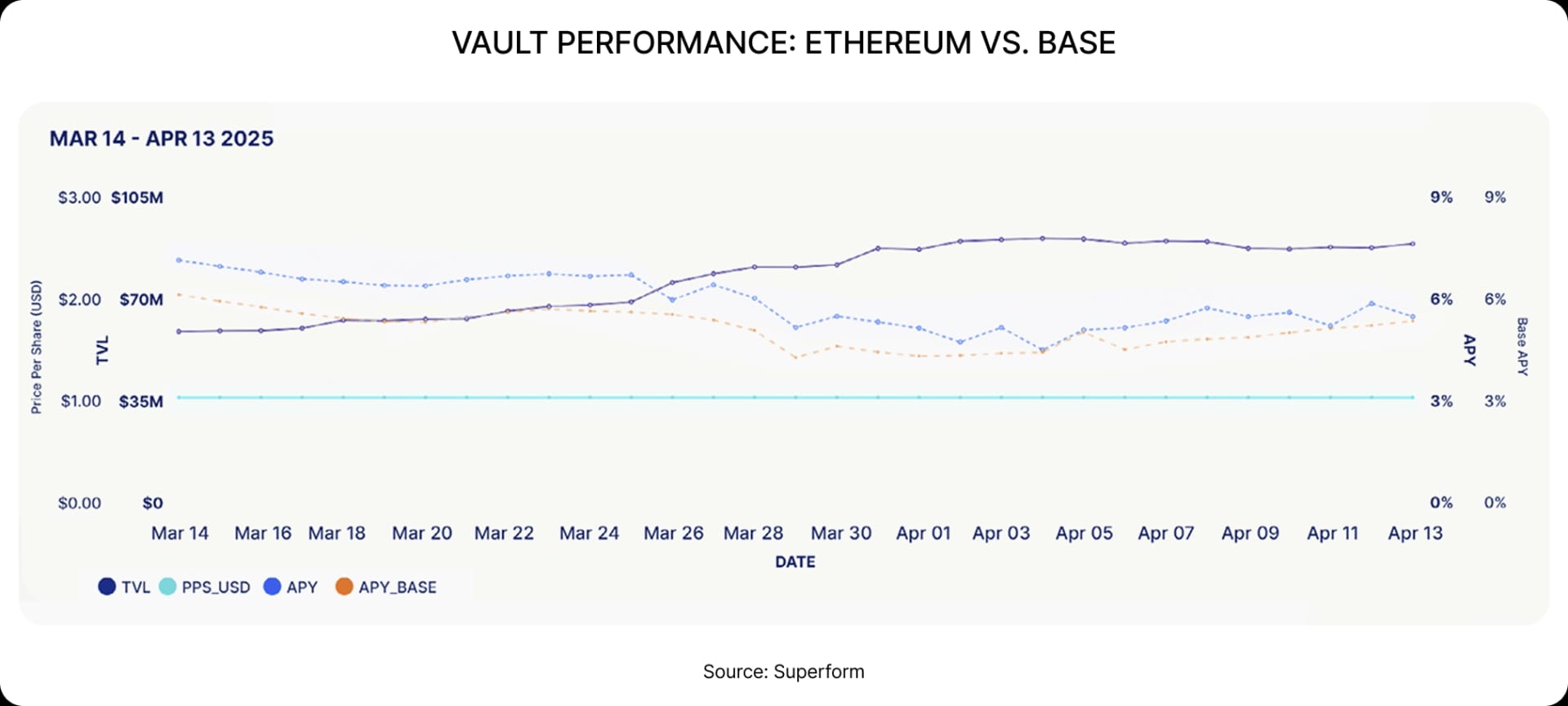
On Ethereum, SuperUSDC experienced strong demand, with TVL growing from ~$65M to ~$88.55M over the past month. Yields dipped in late March to 4.48% but recovered to stabilise between 5 and 6% in April. The Ethereum vault holds ~95% of Superform’s total SuperUSDC TVL, a reflection of the mainnet’s deeper integrations and mature lending markets.
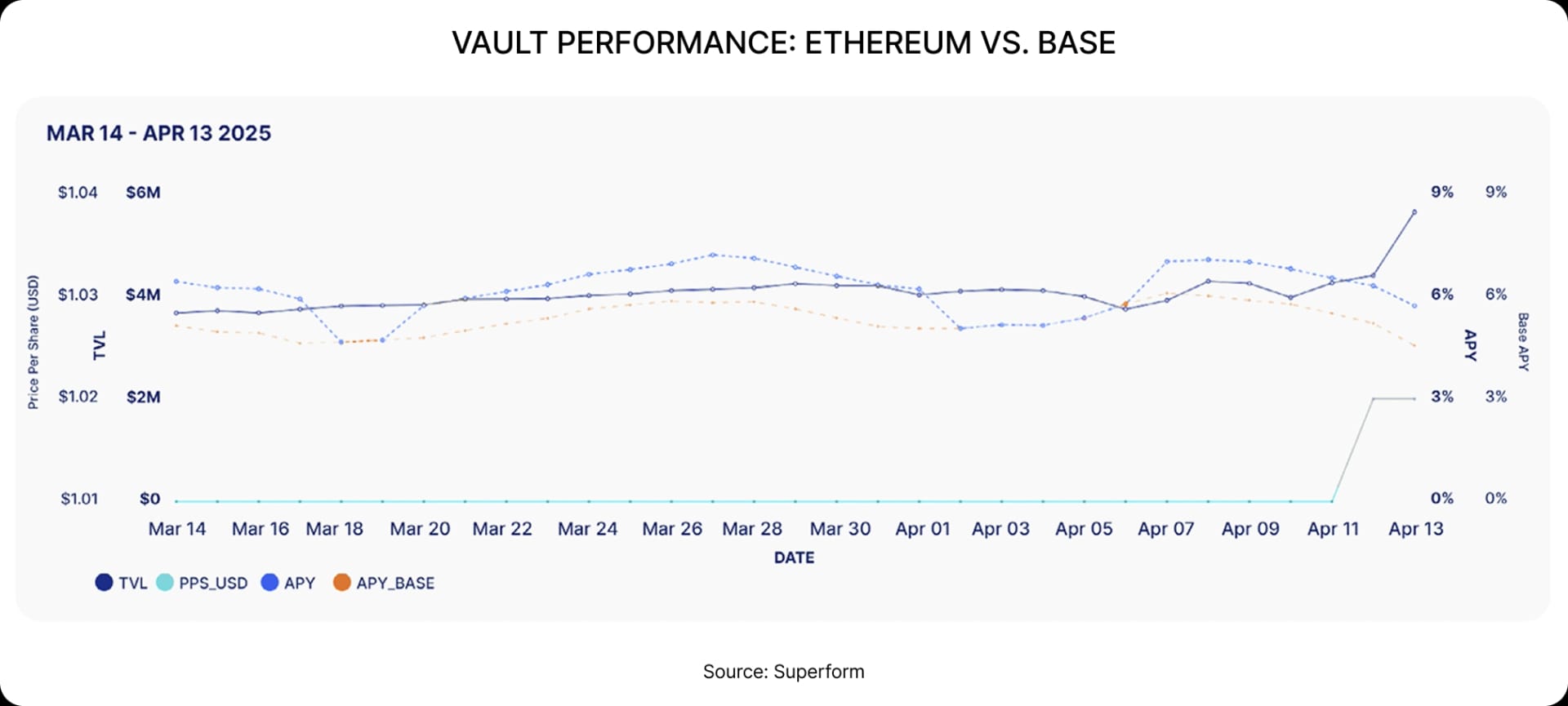
On Base, SuperUSDC’s TVL grew from ~$3.67M to ~$5.63M in the same period. Yields hovered between 4.6 and7% APY, consistently outperforming the base rate by over 1%. The strategy’s efficient cross-chain execution and low fees contribute to its strong relative performance.